

Lieder – A Celebration of Poetry through Song
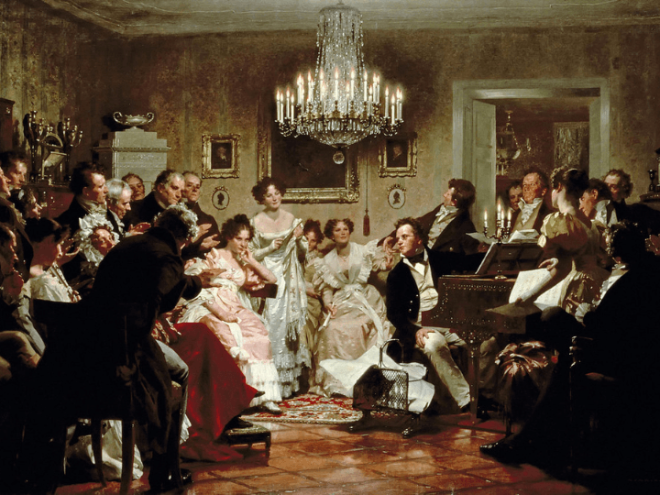
April is National Poetry Month, a widespread, vibrant celebration honoring poetry’s impact on our culture.
At All Classical Radio, we engage with the poetic brilliance of the past and present every day through the music we play on air.
Poetry has long been a wellspring of inspiration for composers. In this post, we’re going to look at a beloved genre of classical music that exquisitely interweaves music and poetry – Lieder, or “songs” in German.
Art Song, a genre of classical music written for voice and piano accompaniment, became increasingly popular in the 19th century for three primary reasons:
- Thanks to advancements in technology and production, more people than ever could afford to bring the keyboard instrument into their homes.
- A growing, musically literate middle class craved music that could be performed at home or in more intimate settings than the concert hall.
- The 19th century was also a reawakening of emotional expression across all art forms, not least music and poetry.
Let’s take a dive into some examples of Lieder that helped epitomize this fusion of poetry and music, ultimately elevating both art forms.
“Erlkönig” (Elf King) by Franz Schubert (1797-1828)
Wer reitet so spät durch Nacht und Wind?
Who rides so late through the night and wind?
Es ist der Vater mit seinem Kind:
It is the father with his child.
Er hat den Knaben wohl in dem Arm,
He has the boy in his arms;
Er fasst ihn sicher, er hält ihn warm.
he holds him safely, he keeps him warm.
– Johann Wolfgang von Goethe (trans. Richard Wigmore)
We can’t discuss Lieder without considering the composer who catapulted the genre into popularity. Franz Schubert’s 600+ songs laid the groundwork for Lieder to flourish in the 19th century through his sensitive text-setting and his addition of “voice” to his piano accompaniments. He was a voracious reader and sought to elevate the poets of his time through music, including Johann Wolfgang von Goethe. Schubert admired the writer and set over 70 of his poems to music.
Goethe is seen as the start of a new era in German poetry, leading the way with verses full of personal expression and embracing all the elements now associated with the Romantic Era: nature, fantasy, love, and longing.
Schubert wrote the fantastical song “Erlkönig” (Elf King) at just 18 years old, inspired by Goethe’s great ballad poem of the same name. Goethe based his poem on a Danish tale of the “Ellerkrone” (Elf Woman), a figure of death. In the song, Schubert uses a relentless piano accompaniment not only to illustrate the horse’s galloping but also to convey the poem’s ominous mood. Goethe’s poem is recited by four different characters: the narrator, the young boy, the father, and the Elf King. Schubert writes each with their own vocal style, and the pace of the piano only slows at the story’s horrific ending.
Read the whole poem with English translation here.
Dichterliebe (A Poet’s Love) by Robert Schumann (1810-1856)
Im wunderschönen Monat Mai,
In the wondrous month of May,
Als alle Knospen sprangen,
When all the buds burst into bloom,
Da ist in meinem Herzen
Then it was that in my heart
Die Liebe aufgegangen.
Love began to burgeon.
– Heinrich Heine (trans. Richard Stokes)
In the generation following Schubert, composers such as Robert Schumann took up the torch in the development of Lieder, leaning into the piano’s full expression as an equal participant in the song’s storytelling. Schumann also had a love of poetry from an early age and seemed intuitively able to elevate the words of German poets through music.
Schumann’s song cycle, Dichterliebe (A Poet’s Love), remains one of his most influential pieces of music. A song cycle, an emerging genre in the 19th century, takes the idea of an Art Song and expands it into a musical novella. Song cycles consist of a group of individual art songs that are narratively connected and performed together as a multi-movement work. To some, the song cycle symbolizes the ultimate synthesis of music and poetry.
For Dichterliebe, Schumann chose 16 poems from Heinrich Heine’s Lyrisches Intermezzo, a collection of 66 songs following an intimate emotional journey of love and heartbreak. Heine’s poetry is known for its bittersweet quality, exploring the discord between idealism and reality.
Read the English translations of all songs from this cycle here.
“Nachtwanderer” (Night Wanderer) by Fanny Mendelssohn Hensel (1805-1847)
Ich wandre durch die stille Nacht,
I wander through the quiet night,
Da schleicht der Mond so heimlich sacht
the moon floats so secretly and gently,
Oft aus der dunklen Wolkenhülle,
often emerging from a dark cover of clouds.
Und hin und her im Tal,
And here and there in the valley,
Erwacht die Nachtigall
a nightingale awakens
Dann wieder alles grau und stille.
but then all is gray and still again.
– Joseph von Eichendorff (trans. Emily Ezust)
Women composers of the 19th century were barred from access to the same educational institutions and career opportunities as their male counterparts. Consequently, they often turned to writing music that could be enjoyed in intimate salon settings—a perfect setting for Lieder—rather than a public concert hall. However, despite their exclusion from public acknowledgement, women composers such as Fanny Mendelssohn Hensel (sister of Felix Mendelssohn) played a pivotal role in the development of Lieder.
Hensel hosted a weekly salon at her home in Berlin, which became a cultural hub in its own right. At these salons, performances of both her own works and those of other artists would take place. And like many of her songwriting contemporaries, Hensel gravitated towards well-known poets of the time, as seen in her song “Nachtwanderer” (Night Wanderer), which sets evocative poetry by Joseph von Eichendorff.
In “Nachtwanderer,” Hensel not only conjures the poetry’s nocturnal setting through expressive piano accompaniment but also fuses the voice and piano parts together so that they are nearly one and the same. The pianist isn’t supporting the vocalist’s poetic expression; rather, it’s an equal “voice” in bringing Eichendorff’s words to life.
Read Eichendorff’s poem in its entirety with English translation here.
“Feldeinsamkeit” (Alone in Fields) by Johannes Brahms (1833-1897)
Ich ruhe still im hohen grünen Gras
I rest at peace in tall green grass
Und sende lange meinen Blick nach oben,
And gaze steadily aloft,
Von Grillen rings umschwirrt ohn’ Unterlaß,
Surrounded by unceasing crickets,
Von Himmelsbläue wundersam umwoben.
Wondrously interwoven with blue sky.
– Hermann Allmers (trans. Richard Stokes)
Johannes Brahms is undeniably one of the most beloved composers of the 19th century, though his orchestral music has long overshadowed his contributions to Art Song. Nonetheless, he holds a pivotal role in the history of the genre. His musical style seamlessly carried over into his songs, including his expansive, elastic phrasing and harmonic richness.
Unlike Schubert, Schumann, and Hensel, Brahms typically favored lesser-known poets when composing Lieder. He also had a keen interest in folksong, evident in both his songwriting and instrumental works. The poetry of Hermann Allmers didn’t enjoy the same compositional frenzy as many of his German contemporaries; however, Brahms’ setting of his poem “Feldeinsamkeit” (Alone in Fields) is nothing short of exquisite.
In “Feldeinsamkeit,” Brahms doesn’t use the piano as a character in the story but rather to evoke the serenity of the narrator’s surroundings. Through a seemingly simple accompaniment, Brahms brings to life the gentle breeze against soft grass, the drifting white clouds, and the profound sense of peace expressed in Allmers’ poem.
Read the whole poem with English translation here.
“Auch kleine Dinge…” (Even Small Things…) by Hugo Wolf (1860-1903)
Auch kleine Dinge können uns entzücken,
Even small things can delight us,
Auch kleine Dinge können teuer sein.
Even small things can be precious.
Bedenkt, wie gern wir uns mit Perlen schmücken;
Think how gladly we deck ourselves with pearls;
Sie werden schwer bezahlt und sind nur klein.
They fetch a great price but are only small.
– Paul Heyse (trans. Richard Stokes)
Hugo Wolf referred to his Lieder as “poems for voice and piano,” and viewed song composition as poetic translation. As the turn of the century approached, composers increasingly turned to large-scale works as a testament to their legacy. In Wolf’s case, however, he took his inclination for songwriting and made it into large, dramatic works for the concert hall by creating hefty song collections organized by the poetry they used.
One such work, Italienisches Liederbuch (Italian Songbook), is a substantial collection of 46 Lieder setting poems from Paul Heyse’s anthology of Italian folk poems translated into German. Heyse, a Novel Prize-winning writer, was known not only for his own writings but also for his translations of writings and folk songs written in languages other than German.
The first song featured in Wolf’s Italienisches Liederbuch, “Auch kleine Dinge…” (Even Small Things…), is a rispetto—an eight-line poem with a specific rhyme scheme (ABABCCDD). In keeping with the poem’s spirit of appreciating the “small things,” Wolf keeps the interwoven voice and piano parts restrained and delicate while maintaining sincere emotional expression.
Read the poem in its entirety with English translation here.
Keep Celebrating Poetry Month
Read other posts by Rebecca Richardson


