On Saturday, October 29, 2022, host Andrea Murray presented at a very special episode of Club Mod, featuring the recent live performance of John Cage and KennethPatchen‘s 1942 radio play The City Wears a Slouch Hat, performed by some of your favorite All Classical Portland hosts as part of 45th Parallel Universe‘s Radio Happening event. This episode of Club Mod also featured interviews with All Classical Portland Artist in Residence María García, and Ron Blessinger, 45th’s Interim Executive Director.
45th Parallel Universe‘sThe Gemini Project performed The City Wears a Slouch Hat at The Old Madeleine Church in early October 2022. Louanne Moldovan directed the cast of All Classical Portland radio hosts Warren Black, Robert McBride, Suzanne Nance, Brandi Parisi, John Pitman, and Sarah Zwinklis.
Radio Happening, a concert event featuring several works by John Cage, explored the powerful role that radio has played in advancing artistic risk taking, innovation, and sharing classical music with wider audiences.
WATCH
Enjoy this video recording of the entire October 2022 performance, featuring James Shields, clarinet; María García, prepared piano; The Gemini Project: Sergio Carreno, percussion, Jon Greeney, percussion, Chris Whyte, percussion Gordon Rencher, percussion; Raúl Gómez-Rojas, conductor; and Ron Blessinger, producer, script writer, sound effects.
ABOUT THE PROGRAM
The City Wears a Slouch Hat was composed in 1942 by John Cage in just under a week, after his original vision for the radio drama was deemed impossible to produce. Initially calling for only the use of “sound effects” as instruments, the original score is thought to be lost.
Instead Cage wrote, assembled, and rehearsed a more modest take in just four days, using tin cans, gongs, alarm bells, foghorns, and other unconventional instruments. This version premiered on the radio in Chicago on May 31, 1942, with a script by Kenneth Patchen.
Slouch Hat tells the tale of a man called “The Voice” who wanders around an imaginary big city, encountering surreal circumstances and mysterious characters. The premiere broadcast received mixed reviews, and as a result Cage’s follow-up projects were cancelled. Today, the work, Cage, and Patchen are now considered pioneers of the American avant garde movement, and are credited with encouraging experimentation in music, technology, radio, and instrumentation.
Thank you to KGW-TV host Lacey Evans and the entire Hello, Rose City! team for welcoming All Classical Portland President & CEO Suzanne Nance and Recording Inclusivity Initiative Chair Adam Eccleston on their program to discuss RII and our first-ever album AMPLIFY! The groundbreaking album is now available to purchase in the All Classical Portland Gift Shop, and available to stream and download on your favorite music site like Apple Music, iTunes, Spotify, Amazon Music, and more.
Learn more about the exciting album and RII in our segment on Hello, Rose City!on the KGW website.
KGW’s Hello, Rose City: All Classical Portland releases AMPLIFY
BEHIND THE SCENES
All Classical Portland’s Recording Inclusivity Initiative is a response to the classical music industry’s longtime need for greater diversity, with the purpose of increasing awareness and opportunity for previously marginalized artistic communities. Learn more at allclassical.org/recordinginclusivity.
All Classical Portland Program Director John Pitman shares his latest review of a new album by British cellist Sheku Kanneh-Mason. The album is called “Song,” and is available now on Decca Records.
Back in January 2022, (which simultaneously feels like yesterday and a decade ago) I interviewed both Sheku and his sister, Isata Kanneh-Mason, about their debut album, “Muse.”In that interview, the siblings talk about the joys and challenges of working together while forging individual artistic paths.
Now, just 9 months later, Sheku has released “Song,” which he considers his most personal album yet. And he’s not alone. There are some beautiful tracks on the album that illustrate the “singing” tone of his instrument and playing style. He also brings in friends from the classical, jazz, and pop worlds to perform both new arrangements of older music and new compositions by Sheku himself. You will get a better sense of what Sheku was striving for – and accomplished – in my conversation with him. His enthusiasm, cheerfulness and humor come across, as does his absolute seriousness when it comes to making music.
All Classical Portland has announced that Navona Records and PARMA Recordings will release AMPLIFY, the first album in All Classical’s Inaugural Recording Diversity Initiative (RII), on Oct. 28. The organization has described RII as “a response to the classical music industry’s longtime need for greater diversity, with the purpose of increasing awareness and opportunity for previously marginalized artistic communities.”
“RII is one of the many ways All Classical Portland is working to increase representation in classical music and public radio,” stated Suzanne Nance, president and CEO of All Classical Portland, in a press release. “We strive to provide access to all, to reflect the diverse and creative communities we serve, and to promote joy and belonging in all that we do. Through RII, we have deepened our commitment to this mission.”
AMPLIFY will feature Jasmine Barnes, Keyla Orozco, Lauren McCall, Coleridge-Taylor Perkinson and Mélanie Hélène Bonis. It will be the 1,000th release from PARMA Recordings.
All Classical Portland and the International Children’s Arts Network proudly announce 14-year-old composer and musician Elaina Stuppler as our 2022 Youth Roving Reporter! Over the next few months, Elaina will work with the producers and hosts of ICAN and All Classical Portland to learn about radio production during her Youth Roving Reporter mentorship.
“I’m most excited about sharing my love of music and creating compelling, uplifting, and inclusive content from a youth’s perspective,” Elaina shares.
Host Amy Faust interviewed Elaina in November 2021 for On Deck With Young Musicians. Hear her episode again.
November 2021: On Deck with Elaina Stuppler
ABOUT
Elaina Rae Stuppler is an award-winning composer and singer. She attended Crossroads School for the Arts in Santa Monica, California, where she studied vocal arts, composing, trombone, and violin, and recently received the U.S. President’s Education Award.
She played trombone in the Colburn School of Music’s Jazz Ensemble and was selected for both the California and Oregon All-State Honor Band. Elaina was a member of the Premiere Ensemble of the National Children’s Choir, has performed in Annie at the Hollywood Bowl, and was invited to sing this spring at Carnegie Hall.
The Oregon Symphony named Elaina as their first Luna Composition Lab recipient, where her piece, Anxious Alignment, had its world premiere at their 125th Gala Anniversary. The Portland Youth Philharmonic and the Metropolitan Youth Symphony have also commissioned works by her. Elaina is a member of the Young Composers Project and will have her orchestral composition debuted in 2023.
YOUTH ROVING REPORTERS
Youth Roving Reporters is an arts journalism mentorship program. Through this innovative, educational program All Classical Portland on-air hosts mentor selected Youth Roving Reporters (ages 14-18), providing them with guidance and insight on what it is to be a broadcaster and arts leader in their community.
All Classical Portland Program Director John Pitman shares his latest review of a new collection of works by William Grant Still.
Regarded by many as the most important black classical composer of the 20th century, and indeed called “Dean of Afro-American Composers” in his lifetime, William Grant Still (1895-1978) remains an important figure in the history of American music. He composed over 200 works, including symphonies, ballets, operas, choral works, art songs and chamber music, and broke social and artistic barriers that helped pave the way for those who followed. Despite his many accomplishments, prejudices left a number of works unrecorded, even long after his death. Fortunately, Naxos of America is taking steps to right this wrong, with their latest release “Summerland,” featuring several world premieres.
John Pitman recently spoke with Avlana Eisenberg, music director of the Boston Chamber Symphony, and renowned public radio journalist Celeste Headlee. Headlee’s maternal grandparents were William Grant Still and pianist Verna Arvey. She holds Bachelors and Masters of Vocal Performance degrees, and has written a thematic catalogue of her grandfather’s music.
Eisenberg shares the story of how this recording came about, while Headlee shares fond recollections of watching Still work, as well as his encounters with artistic bias and racism in American society, which nevertheless did not deter him from breaking barriers and creating beautiful, exciting, and original music depicting the lives of all Americans.
In the world of classical music, it’s easy to get lost in the mystique and lore surrounding its musical figures. At All Classical Portland, we strive to connect to the real, living humans behind the music. What better way to get acquainted with these renowned composers than through their hobbies? Perhaps in doing so, we can form an even deeper connection to their music.
Additional editing and research by Rebecca Richardson, All Classical Portland’s Music Researcher & Digital Producer.
Felix Mendelssohn, visual artist
Gewandhaus by Felix Mendelssohn (1836). Image courtesy of Wikimedia Commons.
Felix Mendelssohn’s artistic achievements were not limited to music. From an early age, Mendelssohn was also inspired to draw and paint with watercolors. Visual art became an essential creative outlet for the composer both during periods of joy and grief. His painting titled “Gewandhaus” was likely created as a memento for a performance he conducted in 1836 in the venue of the same name.
The drawing at the top of this article is also by Mendelssohn, titled “Baumgruppe in Interlaken” (“Group of trees in Interlaken”).
Antonín Dvořák, trainspotter and pigeon fancier
Image courtesy of the Philadelphia Chamber Music Society.
The Czech composer of “From the New World” symphony had two notable passions outside of music – trains and pigeons. Dvořák was fascinated by the technological advancement that trains provided. He almost obsessively tracked the records of trains traveling to and from his local station.
At his summer house in Vysoká, Dvořák meticulously maintained a pigeon loft that included birds gifted by Queen Victoria. While he spent time abroad in New York, the composer visited a zoological garden in Central Park every week to see the 200 pigeons housed there.
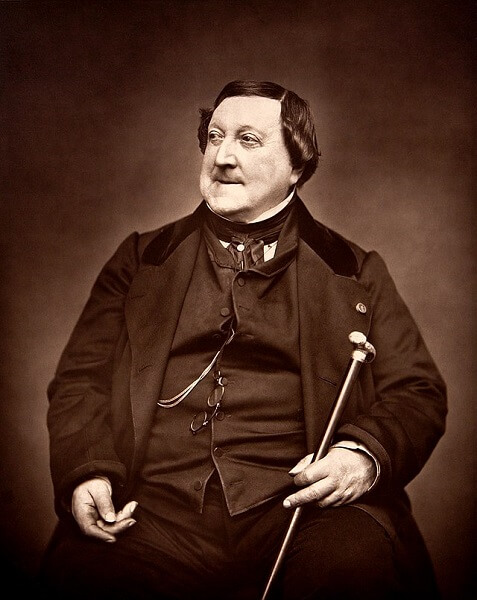
Gioachino Rossini, gourmand
Gioacchino Rossini by Étienne Carjat (1865). Image courtesy of Wikimedia Commons.
Gioachino Rossini achieved such an unprecedented level of fame and success from his operas that he was able to retire in his 30s. So how did the Barber of Seville composer spend his time during his decades of freedom? He cultivated his passion for cooking excellent cuisine, drinking fine wine, and hosting lavish parties. Several culinary dishes were named after Rossini, including Tournedos Rossini (filet mignon with foie gras and truffles), Macaroni alla Rossini (a creamy baked pasta dish with truffles), and the Rossini Cocktail (a spin on a Bellini using strawberries in place of peaches).
Sergei Prokofiev, chess player
Image courtesy of ChessBase.
Sergei Prokofiev is known as one of the giants of 20th-century music, but did you know that he was also an avid chess player? Prokofiev’s passion for the game began as a child and evolved into competitive infatuation throughout the rest of his life. Through this hobby, the composer befriended notable world chess champions such as José Raúl Capablanca (even beating him at a match) and Mikhail Botvinnik.
George Butterworth, dancer
Image courtesy of WarComposers.co.uk.
English composer George Butterworth was especially passionate about preserving and promoting English folk music and dance. In fact, he is known to have said, “I’m not a musician. I’m a professional dancer.” Butterworth co-founded the English Folk Dance Society in 1911 and participated in its dance demonstration team. This video showing Butterworth (among others) performing Morris dancing is the earliest known example of English folk dance captured on film.
Video of George Butterworth dancing.
Arnold Schoenberg, painter and game designer
Chess board designed by Schoenberg. Image courtesy of Wikimedia Commons.
As the “father of modern music”, Arnold Schoenberg is known for fostering new methods of musical composition. While pushing the limits of classical sonority of the time, Schoenberg also occupied himself with several other creative pursuits, including painting self-portraits and designing toys, games, chess sets, and playing cards. Historians speculate that Schoenberg used painting to help process periods of crisis and struggle while the design of games helped the composer harness and expand the creative innovation within his music.
Alexander Borodin, composer (wait, what?)
Alexander Borodin by Ilya Repin (1888). Image courtesy of Wikimedia Commons.
You read that heading correctly! The creator of Prince Igor and In the Steppes of Central Asia was a respected researcher and professor of chemistry by day. Borodin considered composing music to be a source of relaxation from his scientific work, so really, composing was Borodin’s hobby. Borodin was a founding member of the Russian Chemical Society in 1868, and in 1872, he started the first medical courses for women in Russia.
If you enjoyed this article, we have a feeling you’d also enjoy our recent post on musical friendships exploring historical instances of friendship in classical music.
Thank you for joining All Classical Portland’s 39th Birthday Party! It is through your support that we are able to keep the music playing year round and share our limitless concert hall with local musicians and listeners in the Pacific Northwest and around the world.
As an extra special birthday gift in appreciation of your support, we’d like to share with you two exclusive performances by María García, All Classical Portland’s 2022 Artist in Residence. In March 2022, María performed live on Thursdays @ Three in the Roger O. Doyle Performance Studio. Following the live broadcast, she continued playing, and we gladly kept the microphones on and the cameras rolling.
Enjoy these intimate performances of works by Frédéric Chopin.
ABOUT
A celebrated performer and music educator, María García is an enthusiastic proponent of classical works by women and composers of color. As the station’s 2022 Artist in Residence, she is using the opportunity to educate and inspire listeners to explore beyond the traditional canon of the genre.
Sophie Lippert, concert pianist and All Classical Portland’s 2022 International Arts Correspondent, is living and working in Tel Aviv for the year. In this latest version of her Musician Abroad! series, she takes us on a journey through three distinct and colorful components of Israeli culture.
Two mopeds butting heads in front of a cacophonous art display in Tel Aviv, Israel.
Over the past 30 years of playing classical music, I’ve come to be a huge appreciator of contrasts.
Music is full of them!
Contrasts in dynamics: from bombastic fortissimo to whispered pianissimo.
Contrasts in tempo: from scurrying presto to languid largo.
Contrasts in articulation: from sharp, piercing staccato to smooth, undulating legato.
Contrasts in emphasis: from melody weaving a narrative, to rhythm creating an infectious beat, to harmony emerging as a powerful unifying element.
Using these musical tools—dynamics, tempo, and articulation, plus melody and rhythm and harmony—performers are able to convey remarkably different moods, emotions, and ideas. And, often, it’s thesecontrasting elements that make a piece of music so compelling, exciting, and magical.
Chopin: will you provide us with an example?
Sophie Lippert performs an excerpt from Chopin’s Ballade 2, Op. 38, at Classic Pianos Portland.
To illustrate just how amazing contrasts can be, let’s take a section from Chopin’s 2nd Ballade. Chopin begins by employing a soft dynamic, a slow tempo, a legato articulation, and repetitive harmonic and rhythmic patterns to create a sensation of sublime calm and warmth. The soothing sound of this opening section reminds me, in fact, of rocking a baby in a cradle: the music gently undulates back and forth, back and forth.
Just 30 seconds in, however, Chopin does a 180-degree turn and transitions, abruptly and fantastically, to a flurry of right-hand arpeggios that move wildly up and down the keyboard! The mood is anything BUT soothing and calm; there is tremulous turbulence in the cascades of notes, a wild cacophony of emotional expression that sounds, to my ear, distraught and angry. Both the melodies and harmonies are ever-shifting and unsettled; the dynamics fluctuate between booming and explosive fortissimos to murmuring, muttering mezzo-pianos.
And then, amazingly, Chopin leads us back to calm again: drawing from the tropes he used in the first section to lull the piece back to peaceful repose. As the Ballade progresses, Chopin never stops to juxtapose these contrasting moods; the piece continually shape-shifts from one extreme to another, creating an amazing sensation of dynamism, scope, and excitement.
(Note: Chopin’s 2nd Ballade is an incredible representation of pianistic and compositional virtuosity and mastery; I encourage you to listen to all 7 minutes to get the full effect!)
From Chopin, to Tel Aviv!
Sophie gazing over the Mediterranean Sea in Israel.
My appreciation for contrasts leads me now to Tel Aviv, Israel, where I’ve been living since December 2021.
One of the most amazing things about creating a life in Tel Aviv has been observing and experiencing the many remarkable contrasts that Israeli culture contains.
Today, I’m going to focus on three areas in which the contrasts have been particularly astonishing:
The Weather: the bright, searing sun and the expansive, cooling sea.
The Sabbath: a calm weekly respite amidst the wildness of normal life.
The People: the sharpness and softness found in cultural mannerisms.
The People
A festive costume party in a popular alleyway near Shuk Carmel, one of Tel Aviv’s busiest street markets.
Israelis often describe themselves as “rough on the outside, soft on the inside.” There is an undeniable abrasiveness in many of the verbal correspondences that take place here—detectable in the words spoken, the tones of voices used, and the accompanying mannerisms and body language cues. In all these areas, the energy and behavior is sharp, strong, loud, and sometimes even outright aggressive.
Underneath their tough exterior, though, most Israelis have hearts of gold. They are quick to share information, to help when help is needed, and to volunteer support of all stripes—even when the person they are engaging with is a total stranger. In one moment, they’ll honk loudly and impatiently while zooming down a busy city street; in the next, they’ll stop their car to help someone who’s visibly lost or confused. (Sometimes, that person is me!)
When my partner and I were looking for an apartment, a taxi driver spent our entire ride calling his friends in real estate, asking them what units they had available on our behalf. New friends have invited me to share beautiful Sabbath feasts with their families, welcoming me so warmly that I instantly feel at home. And I can’t tell you how many times fellow shoppers have helped me dissect food labels and pricing in the shops, bodegas, and street stands where I buy my groceries.
The Sabbath: Calm Amidst the Storm
Carmel Market on the Sabbath: what is usually a cacophony of shoppers and vendors disappears completely into quiet!
Tel Aviv is a huge, dense, metropolitan city. There is, therefore, noise and activity all the time. Every hour of the day (and night!), people are out and about: walking, shopping, eating, hanging out at cafes, drinking coffee or cocktails. The sounds of the city have a distinct flavor during the middle of the night: the planes on international routes leave between the hours of 11pm and 6am, so the air is filled with sounds of huge jet planes in the wee hours of the morning. And even the cats make noise in the middle of the night—I often hear them yowling when I wake between dreams!
And then, Sabbath rolls around. Between sundown on Friday and sundown on Saturday, the majority of storefronts around the city close their doors and discontinue services. This includes all types of business: from restaurants and convenience stores, to record shops and even the cavernous, enormous, maze-like Dizengoff Mall in downtown Tel Aviv. The most common greeting you’ll hear during this 24-hour period is “Shabbat Shalom” —translating roughly to “Wishing you a peaceful Saturday.”
While observation practices vary, many people in Israel have adopted some form of a “Sabbath practice”. And things really do feel significantly different on Saturdays than any other day of the week. The popular walking streets are thronged with families, as are the beaches and the seaside promenade. And, while the pedestrian traffic increases, the car traffic decreases by over half!
Many people refrain from using any technology during the 24 hours of the Sabbath, which means a dramatic altering of lifestyle. The invitation to turn away from my phone and my computer, and to turn instead to nature, the people around me, and cooking and sharing a meal with loved ones, inspires me–and I hope to bring this inspiration with me when I return to the United States.
The Weather: Bright Sun and Cooling Sea
A quintessential Tel Aviv summer day: the Mediterranean Sea crowned by a cloudless sky.
Arguably, Israeli weather contains very little contrast—especially in comparison to places where the weather varies widely between hot and cool temperatures. Here in Tel Aviv, there’s a pretty narrow window of variation, and there are a few things that are most pervasive:
Wide-open skies, Bright, oppressive sun, Miles and miles of shoreline kissing the Mediterranean Sea!
Cold weather in Tel Aviv is classified by anything below about 65 degrees Fahrenheit; whenever temperatures dip into the low 60s, the majority of Tel Avivians don their big puffy jackets, winter hats, and fur-lined boots. In February and March, while I was swimming in the sea as much as possible, the people walking past me on the beach would be dressed in full winter attire. “It’s freezing!” my Israeli friends moaned.
And that’s because, for the rest of the year, it’s Really Darn Hot. The UV index is impressive, too—it takes only 10-15 minutes in the height of day to be gifted with a mean sunburn. So, one has to be careful—even when escaping into the sea for a much-needed cooling dip!
Speaking of: thank goodness for that water! The Mediterranean Sea is an incredibly important and tempering force in a region of oppressive heat. My daily swims provide welcome relief and respite from the heat hanging in the sky; the water is masterful at both cooling down my physical body, and pacifying the intense energy that the heat brings.
Israel is bordered by the Mediterranean Sea on its entire west side, and though there are certainly less coastal regions of the country, the sea’s tempering, soothing energy is a powerful presence throughout the country.
In Conclusion: An Appreciation of Contrasts
Contrasting hearts on contrasting doors in the quiet Kerem HaTeimanim neighborhood in Tel Aviv.
There’s no question that my musical background has deepened my ability to appreciate—and celebrate—the contrasts contained in Israeli culture. Rather than seeing these opposing elements as disparate or conflicting, I see them as necessary equals; flip sides of the same coin; components that balance each other, and temper each others’ intensity.
Much like the incredible range and scope of Chopin 2nd Ballade, I love the way that Tel Aviv demonstrates the power that can be found in both hard and soft, calm and cacophony, oppressive heat and recentering cool. I’m eager to continue experiencing and embracing these contrasts, and the beauty they contain.
Again, music can be a teacher here: almost always, despite the intensity of contrasts contained within a piece of music, the composition closes with a unifying, stabilizing, and pacifying element: harmonic resolution.
Despite the dissonance and disparateness that precedes it, harmony prevails.
A weekday visit to the bustling Hatikva Market in east Tel Aviv, Israel.Sophie and partner Noah on a sunny stroll in Tel Aviv’s Hayarkon Park.A post-yoga sunset stroll down the Tel Aviv beach.A bright array of street art on a popular pedestrian thoroughfare in Tel Aviv, Israel.
Stay tuned for the next blog in Sophie’s Musician Abroad! series coming in the fall! You can also learn more about Sophie at sophielippert.com
All Classical Portland Program Director John Pitman shares his latest conversation with American cellist John-Henry Crawford. Corazón is Crawford’s second release and reflects the cellist’s own experiences in performing in Mexico and Central America, as well as visiting family members there, such as his brother who is a member of the Peace Corps.
Corazón reunites Crawford with his musical partner, pianist Victor Santiago Asunción in familiar and iconic works by composers including Manuel Ponce, Astor Piazzolla, Heitor Villa-Lobos; as well as some lesser-known composers including Egberto Gismonti. The album reveals the broad range of styles, including popular pieces such as Estrellita, as well as the “edgy” longform work, Le Grand Tango.
Hear John-Henry shares stories of his time spent abroad, learning the languages, customs, culture and yes, food, of the countries of these composers.