As a part of the celebrations this year of the 250th anniversary of the birth of Ludwig Van Beethoven, program director John Pitman is interviewing some of today’s top artists involved in the newest recordings of his music.
American pianist Jonathan Biss has just completed a 9-year journey exploring the piano sonatas of Ludwig Van Beethoven. In his conversation, Mr. Biss shares how each sonata revealed a different side of the composer’s character, which was definitely much more than the scowling face we often see on CD covers and books. The journey was also one of discovery for the pianist himself: Mr. Biss certainly doesn’t feel like he’s in the same place as when he started nearly a decade ago.
In this list, we’ll celebrate some of the great Black opera singers who have passed on into history, and paved the way for Black artists who are still with us. Their stories and recordings are a treasure for listeners and an epiphany for vocalists.
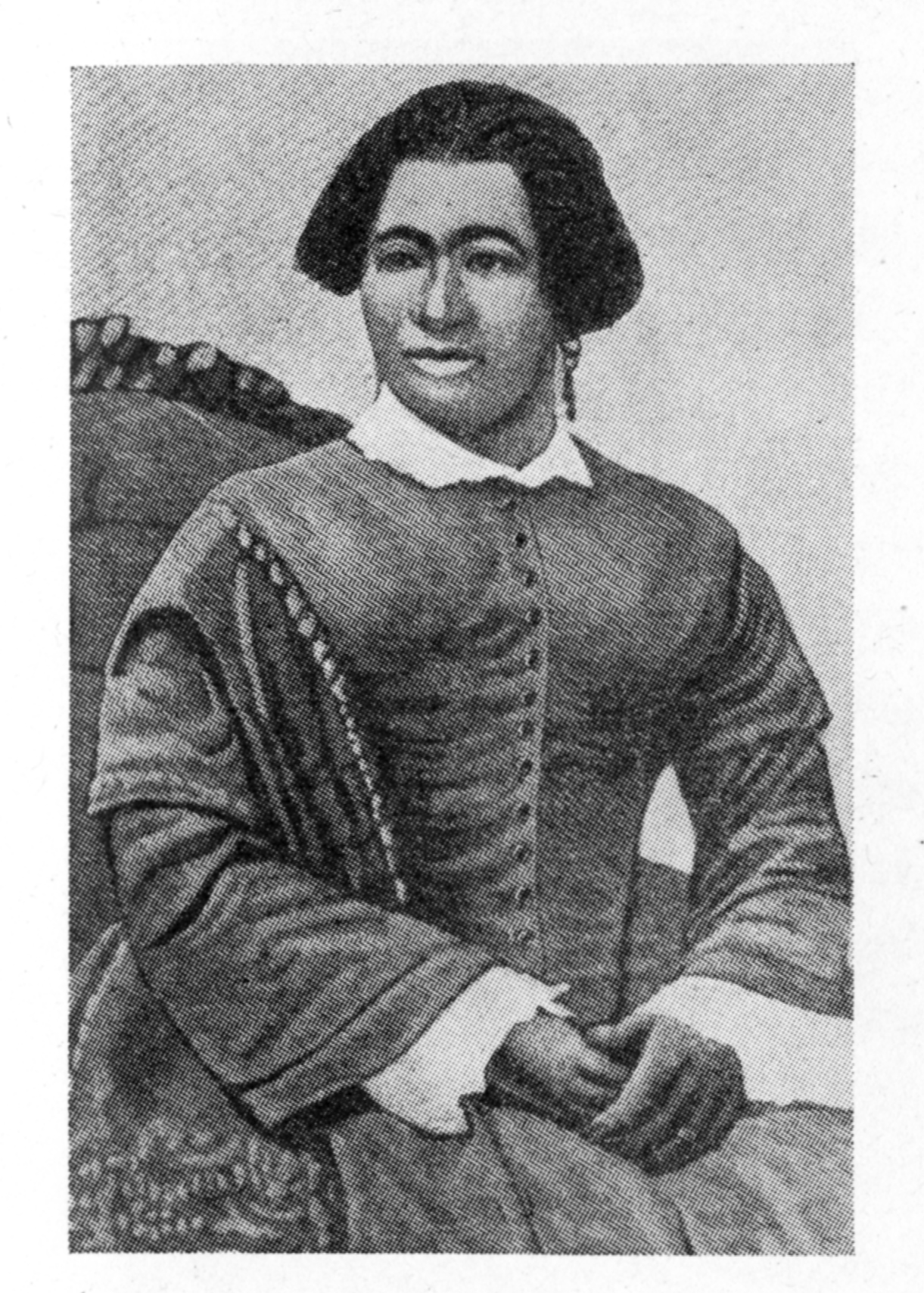
Elizabeth Taylor Greenfield (c.1819-1876) was born into slavery in Mississippi. A pianist, harpist, and foremost a soprano, she challenged listeners’ preconceptions in her 1851 national concert tour. Greenfield showed astonishing resilience performing under outrageous conditions: her manager wouldn’t allow Black patrons to attend her concerts, and reviewers were constantly distracted by the “novelty” of a Black woman beautifully singing operatic repertoire. On March 31, 1853, she debuted at New York City’s Metropolitan Hall, and despite being met with laughter when she took the stage, her performance was critically acclaimed and led to a successful European concert tour, during which she sang for Queen Victoria.
Sissieretta Jones (1868/9-1933) was the first African-American woman to sing at Carnegie Hall, headlining a concert there in 1893. She sang at Madison Square Garden (conducted by Dvořák), toured internationally, and sang for President Harrison and for European royalty. Critics dubbed her “The Black Patti,” after Italian soprano Adelina Patti; Jones disliked the monicker but it dogged her throughout her career. From 1896 to 1915 she toured with the “Black Patti Troubadours,” a company whose performances began with vaudeville acts but closed with staged operatic arias by Jones. In a time of segregated opera, this was Jones’ only opportunity to be an opera singer in her own country. After leaving the stage to care for her ill mother, Jones passed away in relative obscurity, but recent scholars have led efforts to celebrate her legacy.
When Florence Cole-Talbert (1890-1961) was fifteen, she attended a performance of Verdi’s Aida, and was inspired to become an opera singer. In a 1930 interview, she said,
“I was impressed by the opera as nothing had ever moved me before. I sat breathlessly watching the artists, and as the opera progressed, a desire (an impossible desire, so it seemed at the time) took possession of me. I wanted to sing the title role in Aida.”
After study in America and Europe and years of distinguished work as a recitalist and recording artist, Cole-Talbert achieved her dream, performing the title role of Aida in 1927 at the Teatro Communale in Cosenza, Italy.
Cole-Talbert’s career as an educator was central to her legacy. She taught privately, served as Director of Music at Bishop College in Texas and as head of Fisk University’s voice department. One of the young singers she encouraged was Marian Anderson, whose voice so impressed Cole-Talbert that she gave a benefit concert to help fund Anderson’s music education.
Marian Anderson (1897-1993) began singing at 6 as a member of her church’s junior choir. When her family couldn’t afford to pay for high school or music lessons, her church community created a “Marian Anderson’s Future Fund” to provide these opportunities for her. At 17, Anderson won a contest to appear as soloist with the New York Philharmonic, and subsequently began a wildly successful career of study and performance in Europe. Though she was courted by several opera companies, Anderson chose to be a concert artist, specializing in Lieder, oratorio and spirituals. It was in this capacity that Howard University tried to book her a concert at the D.A.R.’s Constitution Hall in Washington D.C., only to be rejected because the Daughters of the American Revolution refused to host Black artists. First Lady Eleanor Roosevelt was so outraged that she resigned from the D.A.R. and helped arrange for Anderson to perform her historic 1939 recital on the steps of the Lincoln Memorial. In 1955, near the close of her career, Anderson made history as the first African-American to sing at the Metropolitan Opera, appearing as Ulrica in Verdi’s Un ballo in maschera.
Like Marian Anderson, soprano Ruby Elzy (1908-1943) started singing in her church choir. She went on to study at Ohio State University and the Julliard School. In 1933 she appeared in the film The Emperor Jones with Paul Robeson. George Gershwin composed the role of Serena in Porgy and Bess for Elzy, and she performed the role over 800 times during the course of her career. Elzy’s life was cut tragically short in 1943 when she died from complications after an operation. Her early death makes this charming interview and performance from 1937 all the more precious. Another treasure is the recording linked below, in which Elzy sings her signature aria “My Man’s Gone Now,” introduced and conducted by Gershwin.
When Serge Koussevitzky heard soprano Dorothy Maynor (1910-1996) in 1939 at Tanglewood, he said (allegedly leaping in joy), “It is a miracle! It is a musical revelation! The world must hear her!” A pastor’s daughter from Virginia, she changed her college major to music at the advice of her choir director, and went on to win a scholarship to Westminster Choir College. Maynor concertized internationally in the 1940s and 50s, and recorded the role of Leonore in Fidelio under Toscanini. In 1963 Maynor retired from the concert stage and founded the Harlem School of the Arts, where she made arts education accessible to countless underprivileged children.
In 1945, Camilla Williams (1919-2012) appeared in Madama Butterfly with the New York City Opera, becoming the first African-American woman to win a contract with a major American opera company. Williams’ performance predated Anderson’s Metropolitian Opera debut by a decade, and she went on to sing the roles of Nedda, Mimì and Aida at City Opera as well. While Williams paved the way for Anderson’s operatic appearance, she also benefited from Anderson’s concert legacy, as a two-time winner of the Marian Anderson Award. In 1963, when Anderson was delayed by traffic, it was Camilla Williams who sang the National Anthem at the March on Washington before Dr. Martin Luther King’s “I Have a Dream” speech. In 1977, Williams became the first Black voice faculty member at Indiana University in Bloomington, where she would teach for twenty years.
Gloria Davy (1931-2012) was a Julliard-educated lyrico-spinto soprano. She had already performed the role of Aida in Nice, Bologna and Zagreb before she became the first African-American woman to sing the role at the Metropolitan Opera. She appeared at the Met in the roles of Nedda, Pamina, and Leonora in Trovatore before moving to Switzerland in 1959, when she chose to base her performance career in Europe. One of Davy’s specialties was 20th century music: she recorded works by Stockhausen and Bowles, as well as singing in 1957 premier of Hans Wernber Henze’s Nachtstücke und Arien. From 1984-1997, Davy taught at Indiana University.
It seems fitting to close this list of history’s divas with the great dramatic soprano Jessye Norman (1945-2019). It was only last year that Norman left us and entered history. Born into segregated Georgia, Norman studied at the Peabody Institute and won the Munich International Music Competition in 1968. She made her operatic debut in Berlin as Elisabeth in Tannhäuser, and became one of the foremost singers on the international stage. Her 1983 Met debut in Les Troyens was the first of countless appearances at that company.
Norman was vocal about the powerful legacy of history’s African-American singers. One of her final artistic endeavors was a project honoring Sissieretta Jones. Of the historical artists who inspired her, she said in 1983,
“They have made it possible for me to say, ‘I will sing French opera,’ or, ‘I will sing German opera,’ instead of being told, ‘You will sing Porgy and Bess.’ Look, it’s unrealistic to pretend that racial prejudice doesn’t exist. It does! It’s one thing to have a set of laws, and quite another to change the hearts and minds of men. That takes longer.”
String Trio debuts with “Silenced Voices” (Black Oak Ensemble)
2020 (specifically, January 27) marks the 75th anniversary of the liberation of Auschwitz, the WWII concentration camp that is symbolic of the persecution and murder of millions of Jews and other groups by the Nazi regime. In addition to the handful of people who survived the camps, a small body of art, including music, has emerged over time. Music written by prisoners of the Nazis who persevered in their art despite the conditions. The string trio Black Oak Ensemble (violinist Desirée Ruhrstrat, violist Aurélian Fort Pederzoli and cellist David Cunliffe) first encounter of much of this music was in a shop in Budapest, and at first, they didn’t know the circumstances of the composers of these works. This debut disc is the result of several years of research and performance, including at the Czech camp at Terezín.
The music is at times filled with a sense of foreboding, at other times sadness, but also great energy and even humor. They were written between the late 1920s (when the first signs of fascism were appearing in parts of Europe) to the 1930s era of persecution, and finally to the last years of the war (most of the composers went from places like Terezín, where artists were kept, to the death camps such as Auschwitz. Only one composer on the disc, Géza Frid, survived the war and lived in the Netherlands to 1989).
The interview is with Cunliffe and Pederzoli, who share their unique connection and admiration for this music which, finally, is “silenced” no more.
The Montenegro-born guitarist Miloš has just released his fifth album, and the first in about 3 years. Sound of Silence (Decca) is, in a way, autobiographical: in 2016, just after the release of his Beatles-inspired disc, Blackbird, Miloš began experiencing a tightness in his hand that affected his ability to play. He eventually stepped away from his busy schedule of successful international concerts, and too the time to heal. He used this time to reacquaint himself with the simple joy of listening. Miloš heard old favorites in new ways (such as Simon and Garfunkel’s melancholy “The Sound of Silence”), and new songs by artists such as Portishead, Skylar Grey and The Magnetic Fields. He eventually regained his full playing ability, and now, with this new album, shares his own playing with listeners around the world once again. Only this time, he’s taking time to enjoy the silence between the notes.
When it comes to traditional Christmas carols, separating history from legend can be as tricky as detangling holly and ivy. Looking forward to our Festival of Carols, we’d like to share some of the true stories behind our favorite carols.
The First Nowell
It is thought “The First Nowell” originated as a Cornish gallery carol. During the 18th century, many small country churches in England lacked an organ, so amateur choirs formed to lead singing from the gallery, or balcony. These choirs were often accompanied by small bands, including a bass instrument, and sometimes a number of strings and winds.
“The First Nowell” was published in in 1823 in William Sandys’s collection of carols from the West Country, Christmas Carols Ancient and Modern. This carol frequently is sung in a beautiful harmonization by the eminent Victorian English church musician, composer, and musicologist, Sir John Stainer (1840-1901).
Adeste Fidelis
Despite the fact that the original text is in Latin, this one is probably not an ancient chant, as it hasn’t yet been traced earlier than the 17th or 18th centuries. The carol first appeared in print thanks to John Francis Wade (1711/2-1786), an English music teacher who created beautiful calligraphic copies of chant for the use of foreign embassy chapels in London. “Adeste fidelis” was included in Wade’s Cantus Diversi pro Dominicis et Festis per annum (1751), and it is unknown whether Wade authored the carol or simply copied it. “Adeste fidelis” also appeared in An Essay of the Church Plain Chant (London, 1782), an anonymous publication that has been attributed to Wade.
The familiar English translation “O Come, All Ye Faithful” was made by priest and author Frederick Oakeley (1802-1880), who served as Canon of the Roman Catholic diocese of Westminster.
Hark! The Herald Angels Sing
“Hark, the Herald Angels Sing” reached its holiday prominence by a circuitous route. The tune, which originally had nothing to do with Christmas, was composed in 1840 by Felix Mendelssohn (1809-1847), as the second movement of his Festgesang or Gutenberg Cantata. Mendelssohn composed this work for the Leipzig Gutenberg Festival, celebrating the 400th anniversary of the invention of the printing press. Mendelssohn’s cantata, for male chorus and brass ensemble, was sung at the unveiling of Leipzig’s new statue of Johannes Gutenberg.
I suspect you can hear the music in your head as you read the tune’s original refrain:
“Gutenberg, du wackrer Mann, du stehst glorreich auf dem Plan!” “Gutenberg, you valiant man, you stand glorious on the square!”
Mendelssohn hoped to publish his Gutenberg tune with English words, but he couldn’t find a text to suit him. In a 1843 letter to Edward Buxton, one of his English music publishers, he explained: “If the right [words] are hit at, I am sure that the piece will be liked very much by singers and hearers, but it will never do to sacred words…”
In 1847, Mendelssohn directed the London premiere of his oratorio Elijah, and one of the alto choirboys was one William Cummings. Little did Mendelssohn know that in the 1850s, Cummings would be the one to attach his Gutenberg tune to a decidedly sacred poem entitled “Hymn for Christmas-Day,” from Hymns and Sacred Poems (1739) by Methodist writer Charles Wesley (1707-1788), the first line of which is, of course, “Hark! The herald angels sing…”
Joy to the World
The text of this carol is actually an adaptation of Psalm 98, from hymnwriter Isaac Watts’s Psalms of David, Imitated in the Language of the New Testament (1719). Watts called the poem “The Messiah’s Coming and Kingdom,” probably not thinking particularly of Christmas or caroling.
In 1836, American composer and music educator Lowell Mason published the text with a tune entitled Antioch in The Modern Psalmist. Mason attributed the tune to Handel, but nobody’s sure what Handel melody Mason had in mind. It is speculated that the tune was inspired by the choruses “Glory to God in the Highest,” or “Lift Up Your Heads, O Ye Gates,” from Handel’s Messiah, on the tenuous ground that the melodies of both begin with the same four notes as Antioch. It’s also possible that Mason adapted it from a preexisting anonymous hymn tune, as scholars have found earlier tunes published in America which resemble Antioch.
All things considered, Handel might be as confused as anyone about the attribution of this tune.
O Tannenbaum
Neither the text nor the music of this song began life associated with Christmas. Tannenbaum actually means “fir tree,” not “Christmas tree,” and songs honoring the evergreen as a symbol of constancy have been popping up in German culture for centuries, including a Westfalian folk song called “O Dannebom.”
In 1820, preacher and folk music collector August Zarnack published a love song entitled “O Tannenbaum” in which the evergreen fir tree is contrasted with a faithless lover. His poem was set to the German folk tune we associate with the carol, which had first been published in 1799 and which has also appeared attached to a German college student song in Latin, “Lauriger Horatius” (“Laurel-Crowned Horace”) and a German folk song, “Es lebe hoch der Zimmermannsgeselle” (“Long Live the Carpenter’s Assistant”).
About this time, the custom of evergreen trees as indoor Christmas decorations was gaining steam in Germany. In 1824, a schoolmaster and organist named Ernst Anschütz borrowed the first verse of Zarback’s arboreal love song and added two festive verses of his own, which transplanted the song firmly into the Christmas canon.
The tune of “O Tannenbaum” continues to serve many purposes to this day, as the tune of several American state songs and college Alma Maters.
O Little Town of Bethlehem
Boston minister Phillips Brooks (1835-1893) spent the Christmas of 1866 in Bethlehem. Inspired by his pilgrimage, he wrote the poem “O Little Town of Bethlehem” in 1868 for the Sunday school at his parish, Trinity Church in Boston.
Brooks asked his church organist and Sunday school superintendent Lewis H. Redner to compose a tune for his carol. Redner (1831-1908), who was an estate agent during the week, reportedly finished his tune the night before it was sung in church. Known as St. Louis, Redner’s tune is still the most popular setting of “O Little Town of Bethlehem” in America.
In England, however, “O Little Town of Bethlehem” is better known to the tune called Forest Green. Originally a folk song called “The Ploughboy’s Dream,” Ralph Vaughan Williams arranged the tune as a setting of “O Little Town of Bethlehem” for The English Hymnal in 1906.
Stille Nacht! Heilige Nacht!
The author of this beloved German carol was Joseph Mohr (1792-1848), a priest who trained as a choirboy at Salzburg Cathedral. In 1818, Mohr was serving at a little parish in the town of Obendorf, in modern day Bavaria. He had written a poem entitled “Stille Nacht! Heilige Nacht!,” and looking for a composer to set it to music, he approached Franz Gruber (1787-1863), organist and schoolmaster at the nearby town of Arnsdorf. Gruber and Mohr introduced their carol on Christmas evening Mass at Mohr’s parish of St. Nicholas: charmingly, Mohr sang and Gruber accompanied on guitar.
Various legends have sprung up around this carol, specifically regarding the guitar accompaniment. Mostly the legends suggest that the church organ was out of order and couldn’t be repaired in time for Christmas. Some versions blame a flood, some have a mouse chewing a hole in the leather of the organ bellows. The truth is, songs accompanied by guitar weren’t that unusual in 1818 Germany, so there’s no need to attribute this guitar accompaniment to a rodent infestation.
Angels from the Realms of Glory
This text was written in 1816 by Scottish writer James Montgomery (1771-1854), a newspaper editor who was imprisoned multiple times for the radical views expressed in his publications. “Angels from the Realms of Glory” is one of 400-odd hymns Montgomery penned.
This carol is popular with several tunes, including Regent Square by English law-student-turnedorganist and Henry Smart (1813-1879).
It is also sung to the French carol tune known as Iris, so christened after James Montgomery’s newspaper, The Sheffield Iris. This particular tune is a Christmas twofer, as it also appears under the name Gloria, particularly when accompanying the text of our next famous carol about angels:
Angels We Have Heard on High
This is a traditional noël, or French carol, which may have originated in the district of Lorraine. In French it’s called “Les anges dans nos campagnes,” and its lyrics are a dialogue between the shepherds and women of Bethlehem, who tell the Christmas story and quote the Latin text of the angels’ biblical nativity song, Gloria in excelsis Deo.
This carol became popular in France and Quebec in the mid-19th century, and it reached English speakers in a 1860 translation by James Chadwick in Holy Family Hymns.
Away in a Manger
This carol appears to be American in origin, though it first attained popularity mis-attributed to Martin Luther. The text appeared in the March 2, 1882 edition of The Christian Cynosure, entitled “Luther’s Cradle Song.” It was accompanied by a wholly inaccurate byline: “The following hymn, composed by Martin Luther for his children, is still sung by many of the German mothers to their little ones.”
Martin Luther (1483-1546) did, in fact, compose Christmas hymns, including “Vom Himmel hoch, da komm ich her” (“From Heaven High I Come To You,”) which he published in 1535 as “A children’s song on the Nativity of Christ.” However, this Luther hymn bears no textual or musical resemblance to “Away in a Manger.”
Like “Angels from the Realms of Glory,” “Away in a Manger” is sung to a variety of tunes. In America it’s best known with the tune Mueller, composed by songwriter and organist James R. Murray (1841/2-1905). In England, “Away in a Manger” is more frequently sung to Cradle Song, composed in 1895 by Philadelphia carpenter-turned-church-music director William J. Kirkpatrick (1838-1921).
We Wish You a Merry Christmas
This one is a folk carol from the West Country of England. It was sung by carolers, or mummers, as they were called in the 19th century: children who sang carols from door to door, expecting treats in return, such as Christmas pudding (which often contained sweet ingredients like figs).
Various versions exist, including this one, quoted as a traditional carolers’ refrain in an 1836 newspaper piece:
We wish you a merry Christmas And a happy new year, A pocket full of money And a cellar full of beer.
Deck the Hall
“Deck the Hall” is a Welsh New Year carol dating from the 16th century, its Welsh title being “Nos Galan.” The song gained popularity after it was published in John Thomas’s Welsh Melodies (1862), with a version of the traditional text rendered by Welsh poet Talhaiarn (1810-1869), plus English lyrics by Thomas Oliphant (1799-1873). However, the English lyrics weren’t an attempt to translate the Welsh, but rather a new poem altogether. What the two texts have in common is a goodly quantity of beverages and fa la las.
Here’s a literal translation of a Welsh version, from A Treatise on the Language, Poetry and Music of the Highland Clans, by Donald Campbell, published in 1862.
The best pleasure on New Year’s Eve, —Fa, la, &c. Is house and fire and a pleasant family, —Fa, la, &c. A pure heart and brown ale, —Fa, la, &c. A gentle song and the voice of the harp, —Fa, la, &c.
So then, Oliphant’s English version isn’t exactly an “ancient Yuletide carol,” but it does reference plenty of British yuletide traditions. Holly was a sacred plant since the time of the Druids, and after Christianity came to the British Isles, the berries were seen to represent Christ’s blood, and the leaves his crown of thorns. The Yule log burning on the hearth through the twelve days of Christmas is another tradition that may have pagan origins. Yule Log rituals include keeping a bit of its wood all year to protect the home from fires and to use in lighting next year’s log.
For Further Reading
If you’d like to know more about the history (not just the legends) behind Christmas carols, check out The New Oxford Book of Carols, edited by Hugh Keyte and Andrew Parrott, which features music, texts and copious historical notes on more than 200 holiday classics.
A Play On Words by All Classical Portland’s Music Researcher & Archivist Emma Mildred Riggle
When I was a kid my little brother and I liked to play Name That Tune when we turned on the radio in the middle of a classical piece, because we were geeks with a bad case of sibling rivalry. One day we were sitting in the back seat of the car, waiting for Dad to finish up at the pharmacy, when we turned on the radio and heard the middle of an orchestral piece that sounded vaguely Mozartean. It wasn’t any symphony we recognized so we fought over whether it was Mozart or Haydn while we waited for the host to tell us the title.
We sat impatiently through three movements, but the piece didn’t end. We heard four, five, seven movements and the thing was still going. At this point our rival composer estimates moved to the back burner as we listened, appalled, to what appeared to be the longest unknown pre-Bruckner symphony.
At last we heard the longed-for host’s voice – just at the moment when Dad loudly reentered the car, innocently unaware of what was at stake. All we could hear from the host amid the door clanging was something that sounded like, “That was a crustacean by Mozart.”
Nowadays kids have it easy. They can go to AllClassical.org, check the playlist and see exactly what was broadcast at what time. I, however, was without internet access, and was consequently left to wonder for years what “crustacean by Mozart” meant. The mystery remained until one day in Sophomore Music History 1 when I opened A History of Western Music and read a single, enlightening word.
Allow me to save you the years of sleep I lost over this by telling you exactly what the difference is between a crustacean and a cassation.
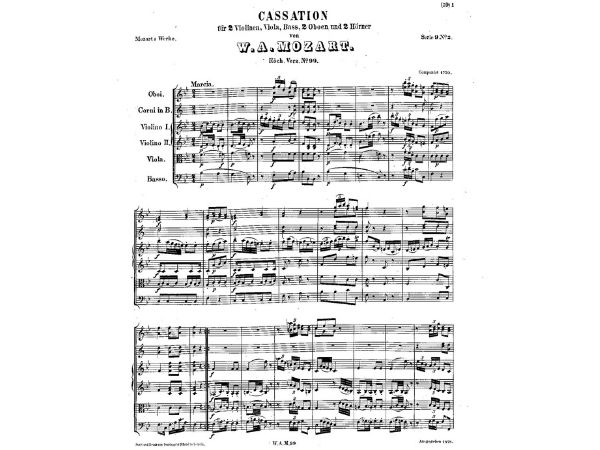
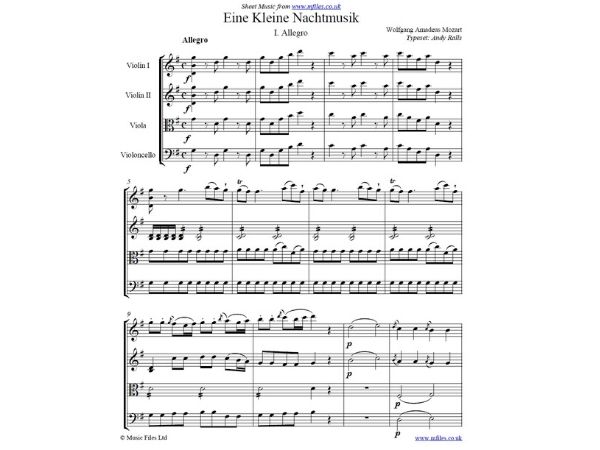
A cassation is a classical-period multimovement instrumental genre, more or less synonymous with serenade. (Fig. 1, 2)
Fig. 1: A cassation by Mozart.
Fig. 2. A serenade by Mozart.
(Note that both the cassation (Fig. 1) and the serenade (Fig. 2) are, in fact, music, not exoskeleton-bearing sea creatures.)
The genre of cassation was most popular in Austria, and was generally intended for nighttime outdoor performances – again, like the serenade, of which the most famous example is Mozart’s Eine kleine Nachtmusik, whose very title [A Little Serenade, literally “A Little Night Music”] refers to that purpose.
If a cassation was pretty much the same thing as a serenade, why did Mozart, Michael Haydn and other classical-era composers opt for a title that sounds like “crustacean” instead of something I could understand in middle school, like “serenade”? As it happens, multiple theories exist regarding the origin of this colorful name.
One theory is that “cassation” derives from the German colloquialism gassatim gehen, which means to “walk about the streets.” A different theory, offered in the Musikalisches Lexicon (1802) by Heinrich Christoph Koch, claims the term derives from the Italian word cessare, which means “to dismiss.” In Koch’s theory, cassations were originally intended as concert closers, thus literally dismissing audiences.
That’s a cassation. A crustacean, on the other hand, is an exoskeleton-bearing member of the phylum arthropoda. Examples include lobsters, barnacles, and woodlice. (Fig. 3)
Fig. 3: a Dungeness crab, which is an example of a crustacean. Crabby is also how I felt after I realized that I had misheard “cassation.” Photograph by Gilphoto, via Wikimedia Commons
What’s more meaningful than a homemade gift – especially when the giver is a composer and the gift is music? Here’s a list of five classical compositions that were given as holiday gifts!
Johannes Ockeghem (c.1410-1497): An Illuminated Chanson
Johannes Ockeghem was a brilliant 15th-century Franco-Flemish composer. Gifted with a deep and beautiful bass voice, Ockeghem spent his career singing, composing, and directing church music, in places like the cathedral in Antwerp, and later, in the French royal chapel under several monarchs.
Ockeghem had a particularly good professional relationship with King Charles VII (1403-1461), who reportedly loved music – we have records indicating the king’s purchase of precious illuminated songbooks for personal enjoyment. As a New Year’s gift in 1454, Ockeghem offered the king a book of his own songs. The present must have been well-received, because for New Year’s Day 1459, Ockeghem went a step further and gave the king a lavishly illuminated copy of one of his chansons, or secular partsongs. We don’t know which of his songs was the gift on this occasion; any of them would be a worthy gift for a royal, as you can hear from Ockeghem’s chanson Ma Maistresse (My Mistress). Like many of Ockeghem’s works, this chanson features a glorious part for bass voices like his own.
Fanny Mendelssohn Hensel (1805-1847): A Year in Piano Music
In 1839, Fanny Mendelssohn Hensel traveled to Italy with her husband Wilhelm and their young son Sebastian. She spent the better part of a year visiting Venice, Rome, and Naples, soaking up the musical and cultural flavors of Italy. One of the musical fruits of this trip was Hensel’s piano cycle Das Jahr, a set of thirteen pieces, one for each month of the year plus an epilogue. The cycle is full of musical images of the Italian trip, like a Tarantella for Carnaval season in “February.” Das Jahr also travels home to Hensel’s life in Berlin: “December” depicts a dramatic snowstorm, and ends by quoting the Lutheran Christmas carol, “Vom Himmel hoch, da komm ich her” (From Heaven High I Come to You).
Fanny Hensel completed Das Jahr on December 23, 1841, and presented the set to her husband as a Christmas gift. Soon afterward the couple embarked on an artistic project together: a beautiful album edition of Das Jahr with epigrams from their favorite poets and handpainted illustrations by Wilhelm, who was a Court Painter and art professor in Berlin.
Clara Schumann (1819-1896): Three Love Songs
Soon after the Hensels’ return from Italy, another artistic couple celebrated their first Christmas as newlyweds. Clara Wieck married Robert Schumann in 1840 after years of fraught courtship. The two had met when Robert was studying piano with Clara’s father Friedrich Wieck, who threw Robert out of the house when he discovered their relationship. Clara and her father were close, and she felt torn between her loyalty to her father and her love for her sweetheart. Clara and Robert eventually had to sue Wieck for the right to marry.
For Christmas of 1840, Clara Schumann presented Robert with three songs she had composed that year: “Am Strande,” (On the Shore), “Volkslied” (Folk Song) and “Ich stand in dunklen Träumen” (I Stood in Dark Dreams). All three songs explore the longing of star-crossed lovers: for example, in “Am Strande,” a woman gazes across the stormy ocean which divides her from her beloved. Perhaps these songs were Clara’s way of telling Robert how she’d felt during the long, challenging courtship that led to their first Christmas together.
Engelbert Humperdinck (1854-1921): A Fairy Tale Opera
One musical holiday favorite actually started out as a Christmas gift. On Christmas of 1890, composer Engelbert Humperdinck presented his fiancée Hedwig Taxer with a singspiel he’d composed for voices and piano. (A singspiel, or “singing-play,” is an operatic work with songs and dialogue – Mozart’s Magic Flute is a famous example.) The libretto was written by Humperdinck’s sister Adelheid Wette, based on “Hansel and Gretel” by the Brothers Grimm. The next year, Humperdinck orchestrated Hansel and Gretel and expanded it into a full opera, in time to offer a draft of the complete work to Hedwig, now his wife, on Christmas of 1891.
In a couple of years, Humperdinck’s charming fairy tale became a sort of Christmas gift to the world, premiering in Weimar on December 23, 1873, under the direction of Richard Strauss. The opera was an instant hit and has been delighting audiences ever since, especially during the holidays.
Edward Elgar (1857-1934): A Musical Christmas Card
In 1897 Edward and Alice Elgar sent a musical gift to everyone on their Christmas card list. Elgar composed a charming little partsong to a traditional text honoring his home, the town of Malvern: “Grete Malverne on a Rocke.” The text came from a book entitled Historic Worcestershire, by W. Salt Brassington (1894). The Elgars had this little song printed on their Christmas cards, as a sort of Victorian corollary to the family photo cards you might send during the holiday season.
In 1907, Elgar’s publisher Novello received a request from their ailing retired employee J.A. Jaeger. Jaeger was Elgar’s close friend, immortalized in the gorgeous “Nimrod” variation from Elgar’s Enigma Variations. Jaeger wanted Novello to turn Elgar’s Christmas card tune into a published carol for all the world to enjoy. In 1908, poet Sharpcott Wensley wrote a Christmas text for Elgar’s tune, which was published as “A Carol for Christmastide.”
Violinist Margaret Batjer has been associated with the Los Angeles Chamber Orchestra for a number of years. In their first CD for the Swedish BIS label, Batjer and the LACO begin with a new violin concerto by Quebec-born composer, Pierre Jalbert. With movements titled “Soulful, mysterious”, and “With great energy”, Jalbert’s concerto is in good hands with Ms. Batjer, no stranger to contemporary music. She ties this newest work to established, mystical pieces by Estonian Arvo Pärt (one of his Fratres pieces), and Latvian Peteris Vasks (Lonely Angel). Completing the circle among these spiritualistic composers, J.S. Bach’s Concerto in A Minor reminds us that whether sacred or secular, Bach approached composition with equal seriousness.
Inspiration for classical music comes in endless forms. Here’s a look at five classical music pieces inspired by young people.
Johann Sebastian Bach (1685-1750): The Well-Tempered Clavier
Johann Sebastian Bach was surrounded by children for most of his life. In addition to fathering more than twenty (!) kids, he also taught choirboys at the St. Thomas School in Leipzig from 1723 to the end of his life. We know he cared about education because he composed beautiful, rewarding music for students, including the 48 preludes and fugues of his Well-Tempered Clavier. In the work’s preface, Bach says that the Well-Tempered Clavier is for young people, but also for grownups who need a bit of fun: “for the use and improvement of musical youth eager to learn, and for the particular delight of those already skilled in this discipline.”
Felix Mendelssohn (1809-1847): Spring Song Op.62 no.6
Among the countless “musical youth” to benefit from Bach’s Well-Tempered Clavier were precocious musical siblings Fanny and Felix Mendelssohn. Fanny Mendelssohn, the elder of the two, was able to perform all 48 preludes and fugues from memory at the age of 12. Her brother Felix went on to compose his own music inspired by children. In 1842 Felix visited London and stayed with his wife’s relatives, the Benecke family. The Beneckes had seven children, with whom Felix enjoyed frolicking in the family garden. One day Felix found himself babysitting these kids alone while he was trying to work on some of his Lieder ohne Worte (Songs without Words). The little ones wanted his attention and kept playfully yanking his hands off the keyboard, a tease which reportedly inspired the frequent clipped-off notes in the piece he was writing: the famous Frühlingslied (Spring Song), Op.62 no.6.
Amy March Beach (1867-1944): Children’s Carnival, Op.25
Amy Marcy Beach was one of the first American women to become an internationally celebrated composer. She was a virtuoso pianist who debuted with the Boston Symphony Orchestra when she was 18, and her Gaelic Symphony (1896) became the first internationally acclaimed symphony by an American woman. In addition to her large-scale compositions, Beach composed a number of delightful works for children, including music for children’s chorus and suites for children studying the piano. Her Children’s Carnival, Op.25, was published in 1894, and it includes this charming movement entitled “Columbine.”
Claude Debussy (1862-1918): Children’s Corner
In 1905, Claude Debussy and his lover Emma Bardac had a daughter, whom they named Claude-Emma (Chouchou for short). Debussy was overjoyed to be a father: at Chouchou’s birth, he wrote to his friend Louis Laloy, “This joy has quote bowled me over and still bewilders me!” Debussy composed his Children’s Corner, a suite for piano, between 1906 and 1908, while Chouchou was a toddler, and dedicated the work to her: “To my beloved little Chouchou, with tender excuses from her father for what follows.” The set offers musical pictures of Chouchou’s playtime and her favorite toys, including a lullaby for her lumbering little velvet elephant Jumbo – whose name Debussy, possibly as a joke, misspelled as “Jimbo.”
John Alden Carpenter (1876-1951): Adventures in a Perambulator
Chicagoan John Alden Carpenter was another composer inspired by the antics of a baby daughter. He was very close to his daughter Ginny: “inseparable,” in fact, according to Ginny’s governess, who wrote of the composer and his little daughter playing games and taking walks together. Carpenter’s orchestral suite Adventures in a Perambulator (1914) comes with copious program notes from the point of view of the heroine of the piece: a baby. In the fifth movement, “Dogs,” the Baby is overjoyed to encounter raucously barking pups during her perambulator ride:
“…It is Dogs! We come upon them without warning. Not one of them—all of them. First, one by one; then in pairs; then in societies. Little dogs, with sisters; big dogs, with aged parents. Kind dogs, brigand dogs, sad dogs and gay. They laugh, they fight, they flirt, they run. And at last, in order to hold my interest, the very littlest brigand starts a game of ‘Follow the Leader,’ followed by the others. It is tremendous!”
For more music for children, tune in to ICAN, our International Children’s Arts Network! You can listen at KQAC HD-2 in Portland, 89.9, or stream anywhere in the world at icanradio.org.
To introduce a pianist saying that he or she started lessons at the age of five is probably not going to raise eyebrows. However, to say that this particular pianist advanced at such a rate that she entered the Curtis Institute at age 13 is something that might catch notice. That’s the first part of Wei Luo‘s story, as the now-19 year old is introduced to the world on the Decca Classics label.
Her disc illustrates her love of Russian repertoire, including some rarities by Rodion Shchedrin (b. 1932), whose Two Polyphonic Pieces were discovered by Luo “by random.” They make for a thrilling and, in her word, “cool” conclusion to her debut disc. Ms. Luo shares more of her story with John Pitman, along with music excerpts.









.jpg)

.jpg)


_(cropped).jpg)