Thank you for joining All Classical Portland’s 39th Birthday Party! It is through your support that we are able to keep the music playing year round and share our limitless concert hall with local musicians and listeners in the Pacific Northwest and around the world.
As an extra special birthday gift in appreciation of your support, we’d like to share with you two exclusive performances by María García, All Classical Portland’s 2022 Artist in Residence. In March 2022, María performed live on Thursdays @ Three in the Roger O. Doyle Performance Studio. Following the live broadcast, she continued playing, and we gladly kept the microphones on and the cameras rolling.
Enjoy these intimate performances of works by Frédéric Chopin.
ABOUT
A celebrated performer and music educator, María García is an enthusiastic proponent of classical works by women and composers of color. As the station’s 2022 Artist in Residence, she is using the opportunity to educate and inspire listeners to explore beyond the traditional canon of the genre.
Sophie Lippert, concert pianist and All Classical Portland’s 2022 International Arts Correspondent, is living and working in Tel Aviv for the year. In this latest version of her Musician Abroad! series, she takes us on a journey through three distinct and colorful components of Israeli culture.
Two mopeds butting heads in front of a cacophonous art display in Tel Aviv, Israel.
Over the past 30 years of playing classical music, I’ve come to be a huge appreciator of contrasts.
Music is full of them!
Contrasts in dynamics: from bombastic fortissimo to whispered pianissimo.
Contrasts in tempo: from scurrying presto to languid largo.
Contrasts in articulation: from sharp, piercing staccato to smooth, undulating legato.
Contrasts in emphasis: from melody weaving a narrative, to rhythm creating an infectious beat, to harmony emerging as a powerful unifying element.
Using these musical tools—dynamics, tempo, and articulation, plus melody and rhythm and harmony—performers are able to convey remarkably different moods, emotions, and ideas. And, often, it’s thesecontrasting elements that make a piece of music so compelling, exciting, and magical.
Chopin: will you provide us with an example?
Sophie Lippert performs an excerpt from Chopin’s Ballade 2, Op. 38, at Classic Pianos Portland.
To illustrate just how amazing contrasts can be, let’s take a section from Chopin’s 2nd Ballade. Chopin begins by employing a soft dynamic, a slow tempo, a legato articulation, and repetitive harmonic and rhythmic patterns to create a sensation of sublime calm and warmth. The soothing sound of this opening section reminds me, in fact, of rocking a baby in a cradle: the music gently undulates back and forth, back and forth.
Just 30 seconds in, however, Chopin does a 180-degree turn and transitions, abruptly and fantastically, to a flurry of right-hand arpeggios that move wildly up and down the keyboard! The mood is anything BUT soothing and calm; there is tremulous turbulence in the cascades of notes, a wild cacophony of emotional expression that sounds, to my ear, distraught and angry. Both the melodies and harmonies are ever-shifting and unsettled; the dynamics fluctuate between booming and explosive fortissimos to murmuring, muttering mezzo-pianos.
And then, amazingly, Chopin leads us back to calm again: drawing from the tropes he used in the first section to lull the piece back to peaceful repose. As the Ballade progresses, Chopin never stops to juxtapose these contrasting moods; the piece continually shape-shifts from one extreme to another, creating an amazing sensation of dynamism, scope, and excitement.
(Note: Chopin’s 2nd Ballade is an incredible representation of pianistic and compositional virtuosity and mastery; I encourage you to listen to all 7 minutes to get the full effect!)
From Chopin, to Tel Aviv!
Sophie gazing over the Mediterranean Sea in Israel.
My appreciation for contrasts leads me now to Tel Aviv, Israel, where I’ve been living since December 2021.
One of the most amazing things about creating a life in Tel Aviv has been observing and experiencing the many remarkable contrasts that Israeli culture contains.
Today, I’m going to focus on three areas in which the contrasts have been particularly astonishing:
The Weather: the bright, searing sun and the expansive, cooling sea.
The Sabbath: a calm weekly respite amidst the wildness of normal life.
The People: the sharpness and softness found in cultural mannerisms.
The People
A festive costume party in a popular alleyway near Shuk Carmel, one of Tel Aviv’s busiest street markets.
Israelis often describe themselves as “rough on the outside, soft on the inside.” There is an undeniable abrasiveness in many of the verbal correspondences that take place here—detectable in the words spoken, the tones of voices used, and the accompanying mannerisms and body language cues. In all these areas, the energy and behavior is sharp, strong, loud, and sometimes even outright aggressive.
Underneath their tough exterior, though, most Israelis have hearts of gold. They are quick to share information, to help when help is needed, and to volunteer support of all stripes—even when the person they are engaging with is a total stranger. In one moment, they’ll honk loudly and impatiently while zooming down a busy city street; in the next, they’ll stop their car to help someone who’s visibly lost or confused. (Sometimes, that person is me!)
When my partner and I were looking for an apartment, a taxi driver spent our entire ride calling his friends in real estate, asking them what units they had available on our behalf. New friends have invited me to share beautiful Sabbath feasts with their families, welcoming me so warmly that I instantly feel at home. And I can’t tell you how many times fellow shoppers have helped me dissect food labels and pricing in the shops, bodegas, and street stands where I buy my groceries.
The Sabbath: Calm Amidst the Storm
Carmel Market on the Sabbath: what is usually a cacophony of shoppers and vendors disappears completely into quiet!
Tel Aviv is a huge, dense, metropolitan city. There is, therefore, noise and activity all the time. Every hour of the day (and night!), people are out and about: walking, shopping, eating, hanging out at cafes, drinking coffee or cocktails. The sounds of the city have a distinct flavor during the middle of the night: the planes on international routes leave between the hours of 11pm and 6am, so the air is filled with sounds of huge jet planes in the wee hours of the morning. And even the cats make noise in the middle of the night—I often hear them yowling when I wake between dreams!
And then, Sabbath rolls around. Between sundown on Friday and sundown on Saturday, the majority of storefronts around the city close their doors and discontinue services. This includes all types of business: from restaurants and convenience stores, to record shops and even the cavernous, enormous, maze-like Dizengoff Mall in downtown Tel Aviv. The most common greeting you’ll hear during this 24-hour period is “Shabbat Shalom” —translating roughly to “Wishing you a peaceful Saturday.”
While observation practices vary, many people in Israel have adopted some form of a “Sabbath practice”. And things really do feel significantly different on Saturdays than any other day of the week. The popular walking streets are thronged with families, as are the beaches and the seaside promenade. And, while the pedestrian traffic increases, the car traffic decreases by over half!
Many people refrain from using any technology during the 24 hours of the Sabbath, which means a dramatic altering of lifestyle. The invitation to turn away from my phone and my computer, and to turn instead to nature, the people around me, and cooking and sharing a meal with loved ones, inspires me–and I hope to bring this inspiration with me when I return to the United States.
The Weather: Bright Sun and Cooling Sea
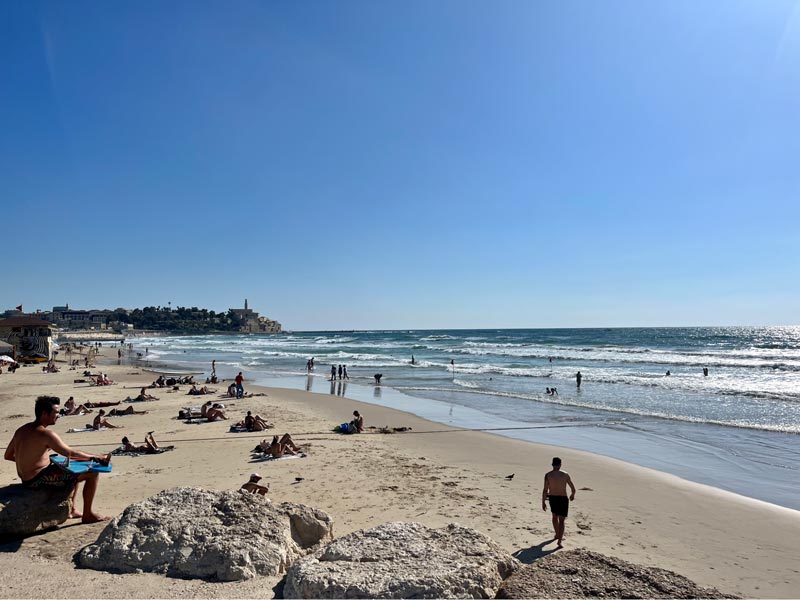
A quintessential Tel Aviv summer day: the Mediterranean Sea crowned by a cloudless sky.
Arguably, Israeli weather contains very little contrast—especially in comparison to places where the weather varies widely between hot and cool temperatures. Here in Tel Aviv, there’s a pretty narrow window of variation, and there are a few things that are most pervasive:
Wide-open skies, Bright, oppressive sun, Miles and miles of shoreline kissing the Mediterranean Sea!
Cold weather in Tel Aviv is classified by anything below about 65 degrees Fahrenheit; whenever temperatures dip into the low 60s, the majority of Tel Avivians don their big puffy jackets, winter hats, and fur-lined boots. In February and March, while I was swimming in the sea as much as possible, the people walking past me on the beach would be dressed in full winter attire. “It’s freezing!” my Israeli friends moaned.
And that’s because, for the rest of the year, it’s Really Darn Hot. The UV index is impressive, too—it takes only 10-15 minutes in the height of day to be gifted with a mean sunburn. So, one has to be careful—even when escaping into the sea for a much-needed cooling dip!
Speaking of: thank goodness for that water! The Mediterranean Sea is an incredibly important and tempering force in a region of oppressive heat. My daily swims provide welcome relief and respite from the heat hanging in the sky; the water is masterful at both cooling down my physical body, and pacifying the intense energy that the heat brings.
Israel is bordered by the Mediterranean Sea on its entire west side, and though there are certainly less coastal regions of the country, the sea’s tempering, soothing energy is a powerful presence throughout the country.
In Conclusion: An Appreciation of Contrasts
Contrasting hearts on contrasting doors in the quiet Kerem HaTeimanim neighborhood in Tel Aviv.
There’s no question that my musical background has deepened my ability to appreciate—and celebrate—the contrasts contained in Israeli culture. Rather than seeing these opposing elements as disparate or conflicting, I see them as necessary equals; flip sides of the same coin; components that balance each other, and temper each others’ intensity.
Much like the incredible range and scope of Chopin 2nd Ballade, I love the way that Tel Aviv demonstrates the power that can be found in both hard and soft, calm and cacophony, oppressive heat and recentering cool. I’m eager to continue experiencing and embracing these contrasts, and the beauty they contain.
Again, music can be a teacher here: almost always, despite the intensity of contrasts contained within a piece of music, the composition closes with a unifying, stabilizing, and pacifying element: harmonic resolution.
Despite the dissonance and disparateness that precedes it, harmony prevails.
A weekday visit to the bustling Hatikva Market in east Tel Aviv, Israel.Sophie and partner Noah on a sunny stroll in Tel Aviv’s Hayarkon Park.A post-yoga sunset stroll down the Tel Aviv beach.A bright array of street art on a popular pedestrian thoroughfare in Tel Aviv, Israel.
Stay tuned for the next blog in Sophie’s Musician Abroad! series coming in the fall! You can also learn more about Sophie at sophielippert.com
All Classical Portland Program Director John Pitman shares his latest conversation with American cellist John-Henry Crawford. Corazón is Crawford’s second release and reflects the cellist’s own experiences in performing in Mexico and Central America, as well as visiting family members there, such as his brother who is a member of the Peace Corps.
Corazón reunites Crawford with his musical partner, pianist Victor Santiago Asunción in familiar and iconic works by composers including Manuel Ponce, Astor Piazzolla, Heitor Villa-Lobos; as well as some lesser-known composers including Egberto Gismonti. The album reveals the broad range of styles, including popular pieces such as Estrellita, as well as the “edgy” longform work, Le Grand Tango.
Hear John-Henry shares stories of his time spent abroad, learning the languages, customs, culture and yes, food, of the countries of these composers.
2022 marks the 157th anniversary of the emancipation of enslaved African Americansin former Confederate states. On June 19, 1865, Union soldiers arrived in Galveston, Texas, with news of the Emancipation Proclamation. It was more than two years since the Proclamation had been issued in 1863, but it took until that day for word of freedom to reach every state.
Beginning in 1986 in Galveston, celebrations of freedom became a tradition on June 19, also known as Juneteenth, Freedom Day, or Jubilee Day (a name inspired by a holy year in the calendar cycle of the Hebrew Scriptures, when prisoners were released, debts forgiven, and slaves freed).
All Classical Portland is reflecting on and commemorating this day with music by African American composers and musicians of African heritage. Tune in at 89.9 FM in Portland or anywhere in the world via the live player on our website.
Here are a few of the musicians you will hear this Juneteenth on Sunday Brunch with Suzanne Nance, throughout the day, and year round on All Classical Portland.
In A Week on the Concord and Merrimack Rivers, Henry David Thoreau described friendship:
“They cherish each other’s hopes. They are kind to each other’s dreams.”
So much beautiful music has come to the world through the mutual encouragement of friends. In this post, we will explore some historic friendships in classical music, when great artists were kind to each other’s dreams.
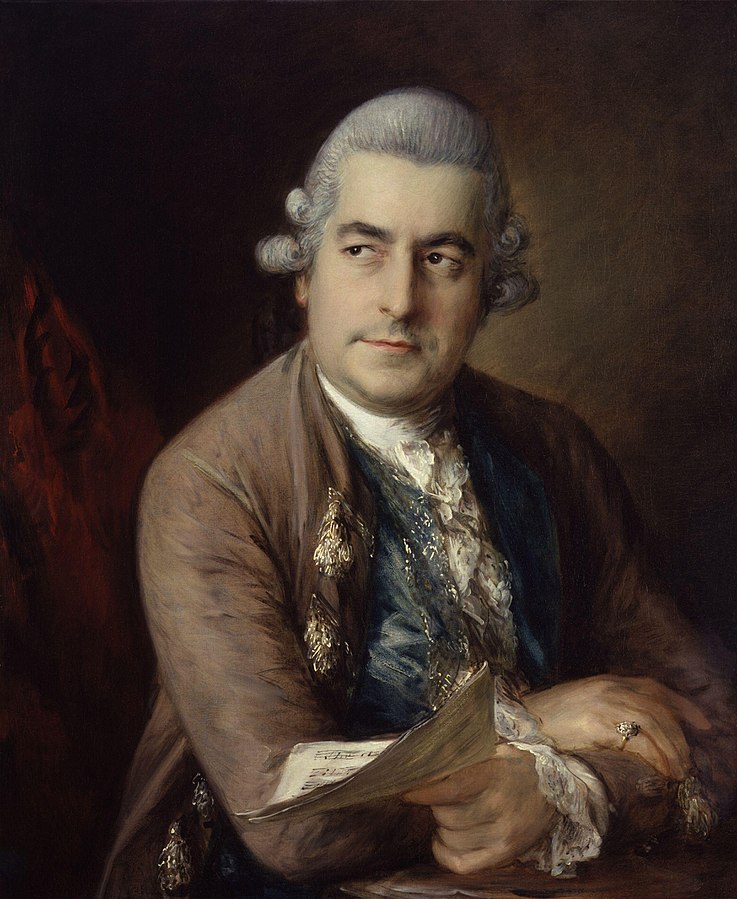
Johann Christian Bach and Carl Friedrich Abel
Johann Christian Bach, portrait (1776) by Thomas Gainsborough. Image courtesy of Wikimedia Commons.
Carl Friedrich Abel, portrait (c. 1777) by Thomas Gainsborough. Image courtesy of Wikimedia Commons.
Johann Christian Bach (1735-1782) was the youngest son of Johann Sebastian Bach and his second wife Anna Magdalena Wülken. J.C. Bach had a lot of older brothers and sisters, but as a young person he also found time to make friends with Carl Friedrich Abel (1723-1787). Carl’s father, Christian Ferdinand Abel, worked with J.S. Bach at the court of Anhalt-Cöthen. The fathers were such good friends that J.S. Bach was godfather to C.F. Abel’s daughter.
When J.C. Bach moved to London to write opera in 1762, he found his friend Carl Friedrich Abel already established there as a bass viol player. In 1764 the two became roommates, and soon they teamed up professionally as well: in 1765 they began a concert series that became known as the Bach-Abel Concerts. Public, ticketed concerts were still a new idea at the time: in the 18th century, most professional music happened at aristocratic courts, opera houses, or places of worship. Bach and Abel shared the duties of directing and performing their series of ten to fifteen concerts each year. The Bach-Abel Concerts were so successful that they continued until 1781.
J.C. Bach’s Keyboard Concerto in E-flat Major, Op. 7, No. 5. Bach performed compositions like this at the Bach-Abel Concerts.
Felix Mendelssohn and Hector Berlioz
Hector Berlioz, portrait (1832) by Émile Signol. Image courtesy of Wikimedia Commons.
Felix Mendelssohn, portrait (1830) by Eckart Kleßmann. Image courtesy of Wikimedia Commons.
If you were searching 1830s Europe for likely musical friends, you might not expect to find the reserved classicist Felix Mendelssohn (1809-1847) spending time with a flamboyant, experimental Romantic like Hector Berlioz (1803-1869). However, the two hit it off when they met in Rome in 1831. Soon afterward, Berlioz wrote to friends in Paris,
“I have met Mendelssohn. He is a fine fellow, and his execution is on a par with musical genius, which is saying a great deal. All that I have heard of his music has charmed me; I firmly believe that he is one of the greatest musical intellects of the day.”
Berlioz goes on to write of their odd-couple Italian tourism. Mendelssohn showed Berlioz ancient Roman ruins: Berlioz, the modernist, was unimpressed. Berlioz poked fun at religion, and pious Mendelssohn was shocked. Despite their differences, they clearly enjoyed their time together: Berlioz summed it up, “I owe him the only endurable moments I enjoyed during my stay in Rome.”
Berlioz and Mendelssohn saw each other again at a concert in Leipzig in 1843. Berlioz wrote that Mendelssohn was “charming, attentive, excellent–in a word, a good fellow all round. We exchanged batons in token of friendship.” Felix’s sister, composer Fanny Hensel, described this baton exchange in her diary, hilariously demonstrating that the two friends remained as opposite as ever:
“In return for Felix’s pretty light stick of whalebone covered with white leather [Berlioz] sent an enormous cudgel of lime-tree with the bark on.”
Felix Mendelssohn’s “Italian” Symphony, composed after his 1831 visit to Italy.
Clara Schumann and Josephine Lang
Portrait of Josephine Lang, courtesy of Wikimedia Commons.
Clara Schumann in 1853, courtesy of Wikimedia Commons.
Josephine Lang (1815-1880) was a German pianist, singer, and composer. She had the admiration and friendship of many contemporary musicians. Felix Mendelssohn and Fanny Hensel both admired her work, and Mendelssohn gave her theory lessons. Robert Schumann also praised Lang’s work in his music journal, the Allgemeine musikalische Zeitung.
Lang taught and composed throughout her life, but her need for work became dire in 1856, when her husband passed away. She was left with only her music career to support her children, while suffering from chronic illness herself. One friend who lent a hand was another single parent, Clara Schumann (1819-1896). Schumann’s husband Robert had died in the same year, leaving her with a large family of children to support. While Clara Schumann was renewing her career as a piano soloist, she found time to arrange a benefit concert for Josephine Lang, in which she performed Lang’s compositions, and helped invigorate Lang’s career as a teacher and published composer.
“Arabesque” for piano, by Josephine Lang
Johannes Brahms and Johann Strauss II
Johann Strauss II and Johannes Brahms at Bad Ischl in 1894, courtesy of Wikimedia Commons.
Music connected Johannes Brahms (1833-1897) to quite a few artistic friends over the course of his life, including some composers of lighter music than his own. Here he is in 1894, photographed at the spa town of Bad Ischl in Austria with Johann Strauss II (1825-1899). Strauss had a villa in Bad Ischl, where he often invited Brahms to parties.
On one of these occasions, Strauss’s stepdaughter asked Brahms to autograph her fan, and on it he wrote the opening bars of Strauss’s Blue Danube Waltz, with the inscription, “unfortunately not by Johannes Brahms!”
Brahms has a reputation as a very serious composer, but clearly he wasn’t too dour to admire the infectiously charming music of the Waltz King.
https://www.youtube.com/watch?v=lQ0fKOpow14
The Blue Danube Waltz by Johann Strauss II
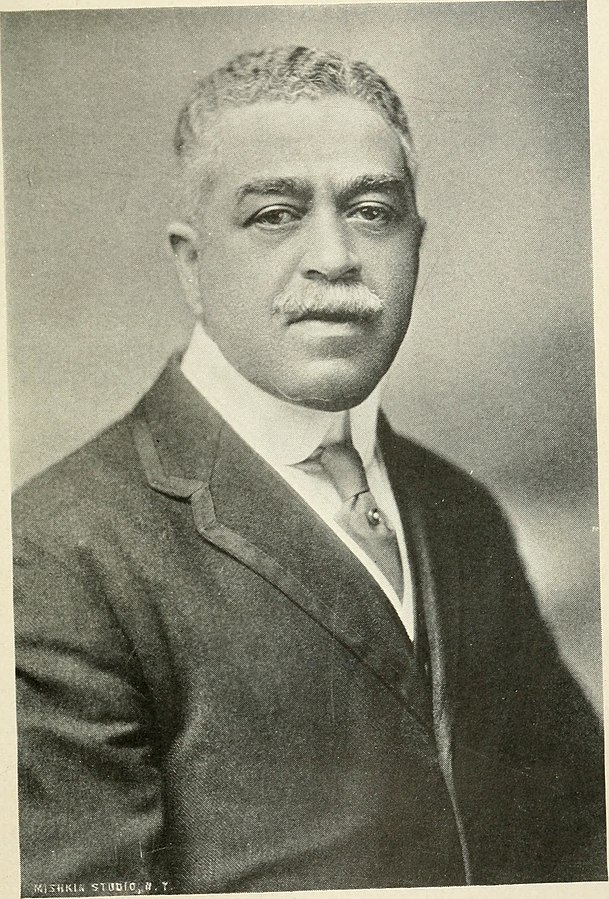
Henry Thacker Burleigh and Friends
H.T. Burleigh in the 1910s, courtesy of Wikimedia Commons.
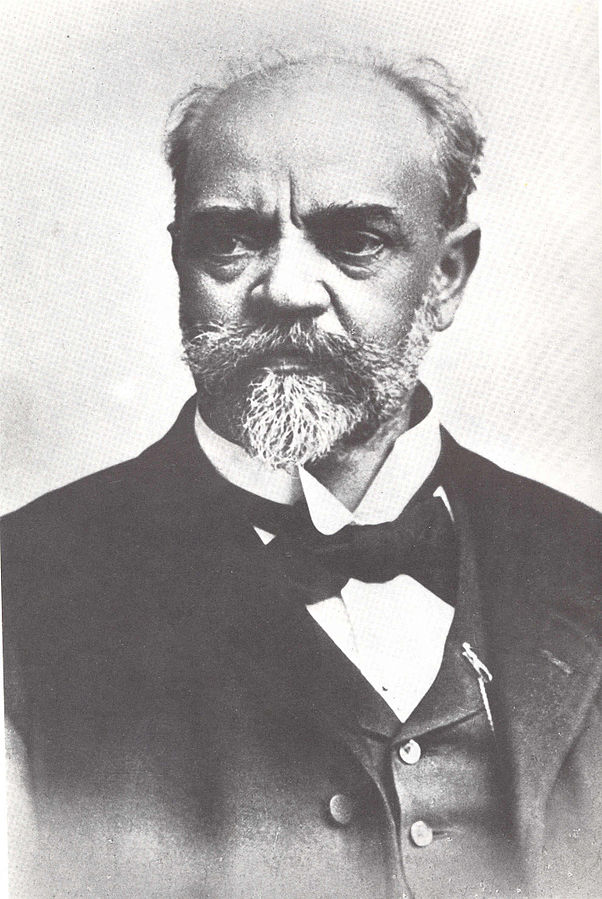
Antonín Dvořák in 1901, courtesy of Wikimedia Commons.
Samuel Coleridge-Taylor in 1905, courtesy of Wikimedia Commons.
In 1892, Bohemian composer Antonín Dvořák (1841-1904) came to the United States to teach at the new National Conservatory of Music in New York. Arts patron Jeannette Thurber had founded the conservatory, and hired Dvořák, because she wanted to encourage the growth of an American musical style. She felt that Dvořák had done so well establishing Czech national music that he could also help American composers find their voice.
Dvořák quickly concluded that African American music was some of the finest material America had to offer. To learn about spirituals, Dvořák turned to Henry Thacker Burleigh (1866-1949), a student at the National Conservatory. Burleigh had learned a vast repertoire of spirituals from his maternal grandmother, who had formerly been enslaved. He recalled the melodies for Dvořák in his beautiful baritone voice, and Dvořák was inspired to create a theme reminiscent of spirituals in his Symphony No. 9, From the New World. Dvořák encouraged Burleigh to create his own compositions based on spirituals, and Burleigh went on to write a classic library of spiritual arrangements for voice and piano, as well as original songs and chamber works.
Burleigh continued to build musical bridges throughout his distinguished career. For more than fifty years, he was a soloist at St. George’s Episcopal Church in New York, where he overcame initial objections because of his color, becoming a beloved and influential musical leader. He also supported the work of English composer Samuel Coleridge-Taylor (1875-1912), accompanying him as a baritone soloist during Coleridge-Taylor’s 1910 tour of the United States.
“Deep River,” arranged for solo voice and piano by H.T. Burleigh
Igor Stravinsky in 1961, courtesy of Wikimedia Commons.
Composer Tōru Takemitsu (1930-1996) was an influential 20th-century modernist, whose music drew on both the Western avant-garde and traditional Japanese music and instruments. One of the works that brought Takemitsu international success was his Requiem for Strings, a piece he composed in 1957 in memory of Fumio Hayasaka, composer for Akira Kurosawa’s film Rashōmon.
Igor Stravinsky (1882-1971) heard Takemitsu’s Requiem for Strings during a 1959 visit to Tokyo, and he was deeply impressed. In a 1989 interview printed in Perspectives in New Music, Takemitsu recalled the occasion, as well as Stravinsky’s subsequent support of his career.
Takemitsu explained that Stravinsky heard the Requiem for Strings “by accident because, when he was in Tokyo…he asked to listen to new Japanese music. The radio stations arranged it. My music was not supposed to be played, but by chance someone played some and Stravinsky said, ‘Please, keep going.’ He listened to my music along with many other pieces. After that he had a press conference and he mentioned only my name. Then he invited me to lunch … After that he returned to the United States and perhaps he spoke about my music to Aaron Copland or something, so I got a commission from the Koussevitsky Foundation. Then I wrote a piece called Dorian Horizon, which was first performed by Aaron Copland conducting the San Francisco Symphony Orchestra.”
Requiem for Strings by Tōru Takemitsu
Margaret Bonds and Langston Hughes
Photograph of Margaret Bonds, courtesy of Wikimedia Commons.
Photograph of Langston Hughes, courtesy of Wikimedia Commons.
American composer Margaret Bonds (1913-1972) discovered the poetry of Langston Hughes (1902-1967) in 1929, while she was a student at Northwestern University. She described the experience in a 1971 interview, quoted in Helen Walker-Hill’s excellent book on Black women composers, From Spirituals to Symphonies:
“I was in this prejudiced university, this terribly prejudiced place…. I was looking in the basement of the Evanston Public Library where they had the poetry. I came in contact with this wonderful poem, ‘The Negro Speaks of Rivers,’ and I’m sure it helped my feelings of security. Because in that poem he tells how great the black man is. And if I had any misgivings, which I would have to have – here you are in a setup where the restaurants won’t serve you and you’re going to college, you’re sacrificing, trying to get through school – and I know that poem helped save me.”
Bonds met Langston Hughes in Chicago in 1936, and they became close friends. She recalled, “We were like brother and sister, like blood relatives.”
Bonds and Hughes would forge a deep artistic connection. Hughes encouraged Bonds’s composing and performing, and sent her poems to set to music. More than half of Bonds’s compositions feature texts by Hughes, including musicals like Tropics after Dark and religious works like The Ballad of the Brown King. Bonds also set many of Hughes’s poems as art songs, including “The Negro Speaks of Rivers.” Bonds felt that this song was her best work: in 1967 she said, “I’ve done more complicated things but I don’t think I’ve ever surpassed it.”
“The Negro Speaks of Rivers,” by Margaret Bonds, text by Langston Hughes
Takemitsu, Tōru, Tania Cronin, and Hilary Tann. “Afterword.” Perspectives of New Music 27, no. 2 (1989): 206-214. Accessed August 28, 2020. https://www.jstor.org/stable/i234538.
Please enjoy this post by All Classical Portland’s 2022 International Arts Correspondent Sophie Lippert! Sophie is a multi-talented Portland musician and artist who has been given the opportunity to live in Tel Aviv, Israel for the next 12 months. She’ll be sharing her journey with us online and on the air with a series of blogs and performances. Stay tuned as we learn more about Sophie as well as the rich music, food, and culture of this region Sophie will call home for the year.
Part 1: Venturing into the Unknown
Music has always been an anchor for me.
Whether I’m tickling the keys of the piano, bowing or plucking my cello, or listening to recorded tracks or live performances, music serves as a constant; a place of refuge, comfort, joy, emotion, and trusted companionship.
My connection to music is especially important when life takes turns toward the unexpected—and it certainly did when I took a monumental leap into the unknown, and relocated to Tel Aviv, Israel in December 2021!
Taking in the view from the Monument to the Negev Brigade in Be’er Sheva, Israel.
From left: Sophie Lippert, Stephanie Schneiderman, Marina Albero, and Amenta Abioto share the stage at The Old Church during Connections Concerts’ September 2019 show.
This transition was a big surprise to everyone in my life—including me. For the previous 10 years, I’d established a life in Portland as a performing pianist, teacher, and entrepreneur. I’d played as a concerto soloist with the Seattle Philharmonic and Olympia Symphony, performed at venues such as the Keller Auditorium and the Portland Art Museum, and collaborated with many of the Pacific Northwest’s finest multi-genre musicians as founder of Connections Concert Series. I’d recorded my first full-length solo piano CD, worked as resident recording artist with Classic Pianos, and played several thrilling Thursdays @ Three programs right here on All Classical Portland.
Beach’s immersion in poetry went beyond texted music. Poetry also influenced music for the instrument Beach played the most: the piano. In honor of National Poetry Month, we present a selection of piano works by Amy Beach, all inspired by poetry. Beach inscribed the scores of the first six selections with poetic quotations, which we’ve reproduced here for you. In the last two selections, the titles themselves are quotations from one of humanity’s oldest surviving books of poetry, the Book of Psalms.
Hermit Thrush, Op. 92
Amy Beach’s two-part Op. 92, Hermit Thrush, takes inspiration both from poetry and from nature. Beach selected two poems, reflecting contrasting moods, to head her two pieces. The first piece, “Hermit Thrush at Eve,” features generous use of the piano’s bass register, and blurry pedaled chords, to suggest the “hush” of John Vance Cheney’s poem, “The Hermit Thrush.” The second piece, “Hermit Thrush at Morn,” places the thrush’s “rapture” within a solemn waltz that preserves wonder of John Clare’s poem, “The Thrush’s Nest.” Beach’s slow waltz is interspersed with bursts of virtuosic joy.
In the scores of both pieces, Beach explains that her music reproduces the song of actual thrushes she heard at the MacDowell Colony, an artists’ retreat in New Hampshire where she spent many happy summers composing.
“These bird-calls are exact notations of hermit-thrush songs, in the original keys but an octave lower, obtained at MacDowell Colony, Peterborough, New Hampshire.” (Amy Beach, Hermit Thrush, Boston: Arthur P. Schmidt, 1922, 3, 43.)
A Hermit Thrush at Eve, Op. 92, No. 1
“Holy, holy! In the hush, Hearken to the hermit thrush, All the air Is in prayer.”
“A Hermit Thrush at Morn,” Op. 92, No. 2, performed by pianist Cecile Licad
Four Sketches, Op. 15
Amy Beach’s Four Sketches, Op. 15, was published in 1892. Each piece in the set is headed by a quotation from a French poet: two from Alphonse de Lamartine, and two from Victor Hugo. An element of the natural world is here as well: three of the four quotations use nature images.
The first piece, “In Autumn,” is a dancelike work in a minor mode, suggesting the nostalgia and melancholy of the fall season. The second piece, “Phantoms,” takes its name from the title of the poem Beach quotes. The quotation clarifies the ghostly reference with a further metaphor about the fleeting life of flowers. The music is a delicate waltz with, again, a nostalgic tone. Its ending is sudden, almost abrupt, further expressing the idea of ephemerality.
The third piece, “Dreaming,” arises from the depths of the piano with a soft rocking figure. One can easily imagine its lyrical melody as “speaking from the depths of a dream,” as its poetic quotation describes.
Beach rounds out the set with the virtuosic “Fire-Flies.” Its accompanying quotation returns to the theme of impermanence. A firefly lives only for a season, but shines brightly while doing so. Similarly, this piece packs a lot of brilliance into its short duration.
In Autumn, Op. 15, No. 1
“Feuillages jaunissants sur les gazons épars” “With yellowing leaves scattered on lawns”
Out of the Depths, Op. 130 (1932) By the Still Waters, Op. 114 (1925)
These are two independent piano works by Beach, each with a title from the Book of Psalms in the King James Version of the Bible. They are late works in Beach’s catalogue, dating from the 1920s and early 30s; Beach lived until 1944. Both pieces are more harmonically adventurous than her thoroughly Romantic Four Sketches.
Out of the Depths opens and closes with a dramatic dialogue between the lowest and middle registers of the piano. Its restless middle passages are extremely chromatic, refusing to settle in one key. The effect is disorienting, reflecting the desperation in the psalm reference.
In contrast, By the Still Waters uses repetition to ground the listener. Its gentle arpeggiated ostinato helps create a feeling of stillness. The work is almost Impressionistic in its use of seventh chords and fragmented melodies, and recalls the serenity of some of Debussy’s piano works, like his Rêverie.
Out of the Depths, Op. 130
“Out of the depths have I cried unto thee…”
From the Book of Psalms (Psalm 130)
Out of the Depths, Op. 130, performed by pianist Kirsten Johnson
By the Still Waters, Op. 114
“He maketh me to lie down in green pastures, He leadeth me beside the still waters, He restoreth my soul … ”
All Classical Portland is proud to announce 16-year-old double bass player Maggie Carter as the 2022 Young Artist in Residence. A home-schooled high school junior, Maggie began music lessons with former Oregon Symphony bassist Nina DeCesare at age nine. She currently studies with Jordan Anderson, Principal Bass of the Seattle Symphony, and performs regularly with the Portland Youth Philharmonic.
“I am deeply honored that All Classical Portland has chosen me and my uncommon instrument,” says Maggie. “I am filled with excitement for everything this position entails. This residency is significant for me because with it, I will grow as an artist and have the chance to share the beauty of classical music. I am particularly looking forward to showcasing solo double bass music with the wider music community.”
Maria Malibran and Pauline Viardot were two of the bel canto era’s greatest mezzo sopranos. Sisters, and daughters of the imposing Spanish pedagogue Manuel García, Malibran and Viardot each left an indelible mark on nineteenth-century opera. Each was also a composer, a quality less celebrated during their lifetimes. Malibran, who died tragically young in 1836, was widely lauded for her singing, but her compositions were less noted. Viardot, who lived until 1910, survived long enough for the Western music world to become more accustomed to the notion of a woman composer. Both left exquisite compositions that offer insight into nineteenth century bel canto – and offer fascinating listening for any music lover.
In this two part series, we’ll explore the careers and music of these two remarkable sisters. We began in Part I with the elder sister, Maria Malibran. Here in Part II, we’ll meet the younger sister, Pauline Viardot.
Program director John Pitman shares his latest conversation with pianist Simone Dinnerstein, where they discuss her new CD titled Undersong. Dinnerstein chose this word, an archaic term meaning “refrain”, which can be found both in the individual pieces (Schumann’s Arabesque, and Kreisleriana; Couperin’s Les Barricade Mysterieuses), and throughout the entire program.
Hear more of their conversation, including Ms. Dinnerstein’s thoughts on the music and the album below.