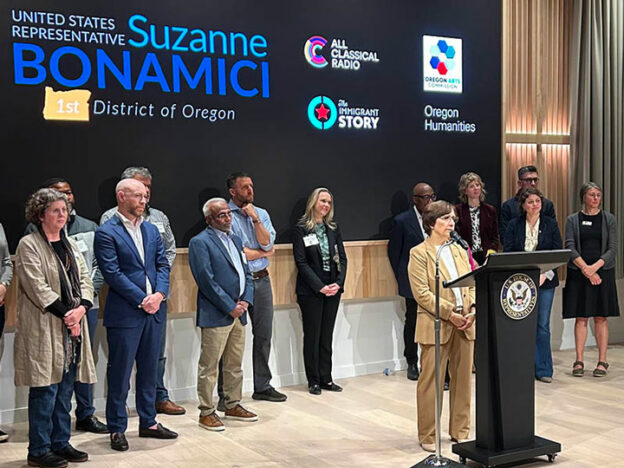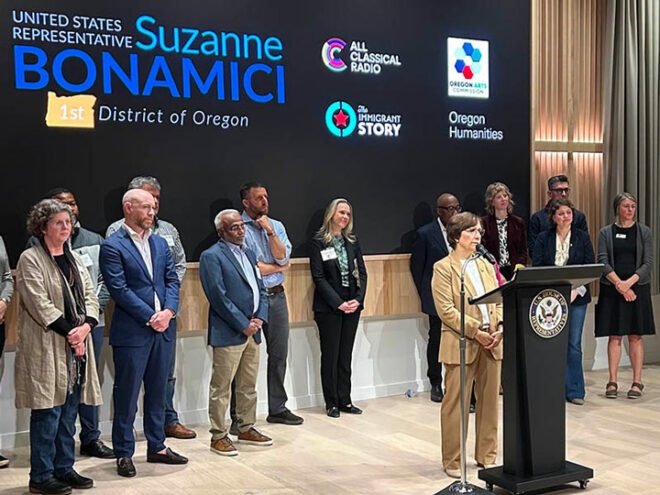
Oregon Symphony’s 2025 Schnitzer Wonder Award recipient is All Classical Radio’s International Children’s Arts Network. The award, which comes with a $10,000 cash prize, will be formally presented at the Oregon Symphony’s Gala and Celebration Concert on Saturday, April 26, 2025.
A service of All Classical Radio launched in 2019, ICAN is a 24-hour arts and music radio station designed for children, families, and classrooms. It is one of the few youth networks in the country, available on regional HD radio, streaming worldwide at icanradio.org, and offering select programs and podcasts on demand. ICAN prominently features the work and voices of student reporters and contributors, ages 4-16.
Inside the Portland HQ, you’ll find a giant CD wall, kid-friendly furniture and more than 30 miles of cabling.
After a whirlwind year of construction, All Classical Radio, KQAC(FM), has at last settled into its new home in Portland, OR.
All Classical’s new headquarters — also dubbed the media arts center — is located on the third floor of the historic KOIN Tower in downtown Portland. It includes five production studios, modernized audio/video technology and a performance hall to foster community.
At All Classical Radio, we’re proud to continually expand our playlist with diverse musical offerings. In celebration of Black History Month, we’re highlighting six Black composers you need to know, whose music we love to play on air all year round. In this post, you’ll also find recommended recordings for the music of each composer if you’re hoping to expand your collection at home!
Robert Nathaniel Dett (1882-1943)
Robert Nathaniel Dett was born in Drummondville, Ontario, a community founded by freedom-seekers who escaped to Canada via the Underground Railroad. Dett received a substantial musical education, first from Oberlin Conservatory where he was the first person of African descent to graduate with a double major in piano and composition, followed by a master’s degree from Eastman School of Music many years later. A significant part of Dett’s legacy lies in his work as a choral conductor at the Hampton Institute (now Hampton University), where he led the program to a new level of artistic achievement and excellence. As a composer, he published around 100 works, many of which were arrangements of folksongs and spirituals written for the Hampton choir.
Recommended recording: The piano suite, In the Bottoms, performed by pianist Luke Welch on the album, Northern Magnolias: Robert Nathaniel Dett Piano Works.
Dorothy Rudd Moore (1940-2022)
Photo by Bert Andrews; courtesy of the American Composers Alliance
American composer Dorothy Rudd Moore knew from a young age that she wanted to compose, a dream that was lovingly supported by her family. Following this dream with persistence, Moore became one of her generation’s leading female composers of color. As a composer, she wrote works for chamber ensemble, piano, and orchestra, in addition to art songs and an opera. Moore also played an essential role in uplifting Black artists by co-founding the Society of Black Composers in 1968 alongside her husband, cellist Kermit Moore. Her work as an educator at several New York-based institutions inspired a new generation of up-and-coming musicians.
Recommended recording:3 Pieces for Violin & Piano performed by Dawn Wohn (violin) and Emely Phelps (piano) on the album, Unbounded: Music by American Women.
Shirley J. Thompson (b. 1958)
Photo courtesy of the English National Ballet
East London native Shirley J. Thompson is a pioneering composer whose music has been claimed as “the present and future of British classical music.” Despite a string of successes early on in her career, Thompson was shut out of the classical music world for many years, during which time she worked in television and composed on the side. However, by the early 2000s, Thompson began establishing herself once more as a compositional force and welcomed a long list of prestigious commissions, including a symphony for the Queen’s Golden Jubilee in 2002. In 2019, Thompson received an OBE (Officer of the Order of the British Empire) for her contributions to music. Her works for orchestra, stage, chamber ensemble, TV, and film are performed all over the world.
Recommended recording: “Marshes, Hamlets and Roaming Cows,” the first movement of Thompson’s innovative symphony, New Nation Rising, performed by the Royal Philharmonic Orchestra on the album, New Nation Rising: A 21st Century Symphony.
Stewart Goodyear (b. 1978)
Photo by Anita Zvonar; courtesy of the composer’s website
Stewart Goodyear is a Canadian pianist and composer whose prestige on the keyboard instrument has long garnered attention, including his infamous “sonathons” where he performs all 32 of Beethoven’s piano sonatas in one day. Goodyear’s work writing music, on the other hand, is a more recent development in his career trajectory. However, in doing so, Goodyear joins a long lineage of concert pianist-composers in classical music, such as W. A. Mozart, Clara Schumann, and Sergei Rachmaninov. Goodyear channels his virtuosic piano playing into many of his own works and regularly programs them in concerts alongside well-known classical music standards, proving the genre’s timeless influence and merit.
Recommended recording: The Kapok for Cello and Piano performed by Inbal Segev (cello) and Stewart Goodyear (piano) on the album, 20 for 2020 Volume IV.
Derrick Skye (b. 1982)
Photo courtesy of the composer’s website
Los Angeles-based composer Derrick Skye has made a name for himself integrating musical practices and connections across cultures from around the world into his work. A student of West African drumming and dance, Persian classical music, Hindustani classical music, Balkan music theory, and more, Skye layers outwardly disparate traditions into groundbreaking works for the concert hall. He uses rhythm, and the embodiment of rhythm through movement, as a unifying feature for much of his music, often collaborating with choreographers and even synchronized swimmers. Skye’s compositional oeuvre includes works for orchestra, chamber ensemble, choir, and film.
Recommended recording: The orchestra work, Prisms, Cycles, Leaps, performed by Bridge to Everywhere on the album, Prisms, Cycles, Leaps.
Jon Batiste (b. 1986)
Photo courtesy of Boston Symphony Orchestra
Jon Batiste is a musical artist of many trades – singer, songwriter, multi-instrumentalist, composer, bandleader, and TV personality. Batiste rose to prominence as the musical director for The Late Show with Stephen Colbert from 2015-2022, though he has been releasing recordings of his works since 2005 (several of which have won Grammy Awards). Batiste grew up in Louisiana, the son of a jazz musician and professional singer, and was consequently exposed to a wide variety of musical influences throughout his upbringing. Since emerging on the professional scene, Batiste has redefined what it means to be a modern-day musician and is consistently breaking down barriers. In 2020, he won an Academy Award for Best Original Score for the Disney/Pixar film, Soul. The film also earned Batiste a Golden Globe, a BAFTA, an NAACP Image Award, and a Critic’s Choice Award.
Recommended recording: Chopinesque performed by Jon Batiste on the album, Hollywood Africans.
Keep Learning
If you enjoyed this post, check out a few more from the Arts Blog celebrating the lives of Black musical artists:
Radio World’s 2025 eBook provides readers with a look inside more than a dozen recently built radio studios. Published annually, it has become one of our most popular recurring features. Engineers, managers and suppliers comment on the design choices and the technical decisions involved. Featured broadcasters include Audacy, SiriusXM, Cumulus, Chicago Public Media, All Classical Radio, and more.
American pianist Simone Dinnerstein’s latest album, The Eye is the First Circle, features iconic American composer Charles Ives’ Concord Sonata. The album is a live recording of Dinnerstein’s multimedia production at the Alexander Kasser Theater in Montclair State University, New Jersey.
The Eye is the First Circle was inspired in part by a quote from Ralph Waldo Emerson’s essay Circles: “The life of man is a self-evolving circle, which, from a ring imperceptibly small, rushes on all sides outwards to new and larger circles, and that without end.”
All Classical Radio host John Pitman speaks with Simone about this monumental and challenging yet profound and personal piece – and journey, by the artist in this case – learning, performing and recording a piano sonata inspired by American literature, the landscape and experience.
Hear their conversation below:
Simone Dinnerstein’s The Eye is the First Circle is available to stream and purchase on her website simonedinnerstein.com.
The composers we love have written some of the most iconic pieces in classical music. Works like Beethoven’s Für Elise and Symphony No. 5, Mozart’s Marriage of Figaro, Tchaikovsky’s TheNutcracker, and many more are synonymous with the genre of classical music and recognized by classical music appreciators of all levels. While these composers wrote some of the most quintessential works in the genre, many listeners may not be aware of their “hidden gems.”
Today, All Classical Radio is exploring lesser-known works by legendary composers. We are highlighting pieces that are not particularly popular in the concert hall, were written earlier on in the composer’s career, or were written outside of the composer’s typical instrumentation or genre. If you enjoy these composers, we think you will enjoy some of their more overlooked music as well.
Ludwig van Beethoven – 6 Bagatelles, Op. 126
Beethoven is often regarded as the greatest composer to have ever lived. Most famous for his nine symphonies, including the Eroica Symphony or the Pastoral Symphony, as well as his concerti and piano sonatas, it is inevitable that some of his compositional output has gone unnoticed to some extent. While it can be difficult to categorize any of Beethoven’s works as a “hidden gem,” his Bagatelles, Op. 126 were composed as a complete set of six light and short works for piano and were some of his last works for piano. Upon getting this work published, Beethoven stated that these bagatelles were “the best pieces of this kind I have written.”
W. A. Mozart – Divertimento for 3 Basset Horns No. 5 in B-flat Major
Mozart composed over 600 works in his 35 years of life. Given his immense popularity, it can be difficult to see any of his works go unnoticed; however, one notable hidden gem for Mozart is his Divertimento for 3 Basset Horns No. 5. A basset horn is an instrument within the clarinet family. While most clarinet players are familiar with Mozart’s quintet and concerto, not many know of his five divertimenti for basset horn (a divertimento is an 18th-century genre of music that is usually light-hearted and written for small ensembles). This work sets itself apart from the already unique instrumentation by beginning with a slow Adagio movement and ending with a Polonaise, a Polish dance.
Johannes Brahms – Geistliches Lied
Considered one of the “Three B’s” of classical music, along with Bach and Beethoven, Brahms was a leading figure in the Romantic period. A few exemplary pieces include his First and Third Symphonies, Piano Concerto No. 1, Hungarian Dances, Wiegenlied (also known as “Lullaby”), and many chamber music works that capture the composer’s tender and warm sound. Perhaps a lesser-known work that encapsulates the gentle and romantic Brahmsian voice is his choral work, Geistliches Lied. This piece was originally part of a series of contrapuntal exercises (counterpoint in music is the relationship between two or more simultaneous musical lines) that were traded back and forth between Brahms and violinist Joseph Joachim. Regardless of its origins, the work’s mournful character is full of complexity.
Ralph Vaughan Williams – Piano Quintet in c minor
British composer Ralph Vaughan Williams was a key figure in influencing the style of 20th-century British classical music. An avid collector of English folk songs, Vaughan Williams used these traditional melodies to craft his unique folk sound, which can be heard in works like Fantasia on a Theme by Thomas Tallis, The Lark Ascending, and English Folk Song Suite. However, many of his earlier works, such as the Piano Quintet in c minor, were hidden from the public once he had developed his “mature” style. While this quintet contains hints of who the composer was soon to become, it was shelved for over 80 years after its premiere. You will find that this hidden gem with violin, viola, cello, double bass, and piano has the romantic elements of Brahms and Dvorák.
Pyotr Tchaikovsky – String Quartet No. 3 in e-flat minor
Many listeners are familiar with Tchaikovsky’s ballets, such as The Nutcracker, Sleeping Beauty, and Swan Lake, or perhaps his symphonic works such as Symphony No. 5 and the 1812 Overture (the one with the cannons). While his large-scale works are frequently performed all over the world, Tchaikovsky’s handful of chamber or small ensemble compositions don’t receive the same level of attention. Only eight pieces in his catalog of 169 works are chamber music, and only three of those chamber pieces are string quartets, with his first string quartet being the most popular. To shed light on the composer’s small and often overshadowed chamber music output, we’re highlighting String Quartet No. 3. This work may not be as lively or grand as some of Tchaikovsky’s symphonic works, but it is just as expressive, dramatic, and powerful. Dedicated to violinist and teacher, Ferdinand Laub, a friend of Tchaikovsky, the opening movement is full of melancholic expression, and the third movement, Andante funebre e doloroso, is an emotional funeral march filled with grief as it commemorates Laub’s death.
Giacomo Puccini – Crisantemi
Known as one of the greatest Italian composers, Giacomo Puccini’s operas are among the most recorded and performed works in the genre. Arias such as “O mio babbino caro” (“Oh my dear Papa”) from Gianni Schicchi and “Nessun dorma” (“Let no one sleep”) from Turandot are recognizable even in popular culture, from movies, TV, commercials, and more. Puccini himself recognized his operatic talent when he said, “Almighty God touched me with his little finger and said: ‘Write for the theatre – mind, only for the theater!’ And I have obeyed the supreme command.” While his operas are immensely popular, many may not know Puccini’s instrumental and chamber music. Let’s listen to his prelude for string quartet, Crisantemi. Produced in a single night, Crisantemi is an elegy written for Puccini’s friend, Prince Amadeo, Duke of Aosta. Although this piece stands on its own, Puccini ended up using themes from this string quartet in his opera, Manon Lescaut.
Do you recognize any of these hidden gems we explored today? Perhaps you have a favorite lesser-known work that we didn’t mention? Get in touch to let us know your favorite composer’s hidden gem!
The home of Fine Arts programming in Portland, Ore., and its surrounding communities is the recipient of a cash award from the National Endowment of the Arts.
KQAC-FM and its All Classical Radio operation is receiving $20,000 as part of the NEA’s Grants For Arts Projects bequeathments.
The grant will support All Classical Radio’s Access Recording Project, set to launch later this year.
KQAC-FM/Portland, OR, known as All Classical Radio, has received a $20,000 grant from the National Endowment for the Arts (NEA) to support its upcoming Access Recording Project. This initiative is designed to lower financial hurdles to quality recording and performance facilities for artists and groups from diverse backgrounds.
Cellist Joshua Roman began to experience something beyond a case of Covid, early in the pandemic. It soon became apparent that the virus had advanced to become long Covid, which consists of symptoms that vary widely from one person to the next. While coming to terms with this life-changing condition, Joshua had to learn a new way of approaching the playing of the cello, performing publicly, and collaborating with musicians.
Immunity, Joshua’s first solo album, is a form of document of those experiences, but also functions as a line of communication to his audience, especially as a connector to others with long Covid.
In this interview with All Classical Program Director John Pitman, Roman shares his encounters with this serious, long-term illness, how it changed his approach to music and performing, and how it strengthened his connections with friends and fellow musicians, and the people who come to hear him play.
Hear their conversation below:
Joshua Roman’s Immunity is available now on Bright Shiny Things on the artist’s website, joshuaroman.com.