Many people are at home right now – working from home, studying at home, isolating at home. Have you wondered what self-isolation would have looked like for classical composers? Let’s explore some historical images and meet some Composers at Home.


Many people are at home right now – working from home, studying at home, isolating at home. Have you wondered what self-isolation would have looked like for classical composers? Let’s explore some historical images and meet some Composers at Home.

Today we call them art songs, but when this specific genre first appeared in the late 18th century, they were simply “songs,” nearly always scored for what is now a classic combination: piano and voice. At the time, the Industrial Revolution was helping to create a new class of music lovers. The new Middle Class was wealthy enough to want access to musical entertainment at home, but not wealthy enough to hire live-in court musicians like the aristocratic classes. What they could afford was the perfect new domestic instrument: the piano.
The ability to play the piano and sing became a status symbol for middle and upper-middle-class families, especially among women (as you might know from the novels of Jane Austen or the Brontë sisters). This made home music a lucrative market for composers. The earliest Lieder [pronounced “leader”], or German art songs, were written for voice and simple piano accompaniment, so that home musicians could accompany themselves or their friends at the piano.
Throughout the 19th century, the genre of art song developed into a sophisticated art form for the concert stage as well as for the home. However, in one sense, it’s never abandoned its domestic beginnings: most art songs are still scored for voice and piano. In this post, we’ll take a lightning tour of art song history, featuring a few of the countless great works in this genre. In addition to the videos, click on the text links to listen to a few more art songs.
Wolfgang Amadeus Mozart (1756–1791) was one of the first composers to explore the expressive capabilities of the Lied [singular of Lieder, pronounced “leet”]. Many of Mozart’s Lieder were composed for the growing domestic song market. His Lieder offer the same natural vocal writing he brought to opera – and the same wide-ranging dramatic sense. For example, his “Abendemfindung” (Evening Thoughts) is a tender reflection on mortality; in contrast, his “Das Veilchen” K. 476 (The Violet) is a playful, rather snarky setting of a poem by Goethe about a dramatic violet’s tragic love for an oblivious shepherdess.
Other Classical composers who wrote in the burgeoning Lied genre include Louise Reichardt, Joseph Haydn, and Ludwig van Beethoven, who invented the song cycle (more on that next!).
In 1816, Ludwig van Beethoven had the idea of writing a set of six Lieder with an overarching narrative: his An die ferne Geliebte (To the Distant Beloved). This new genre came to be known as a Liederkries, or in English, a song cycle. Some song cycles tell a story, some have a common theme, and some are merely meant to be sung in a series for aesthetic reasons. They’re a bit like the 19th century’s version of the record album.
Franz Schubert (1797–1828) was a master of the Lied. He composed more than 900 Lieder, many of which had their premieres at musical home gatherings, which Schubert’s friends delightfully called Schubertiades. Schubert perfected the song cycle in works like his narrative cycle Die schöne Müllerin (The Beautiful Miller Maid), as well as cycles linked by a common author, like his Op.52 settings from Sir Walther Scott’s Lady of the Lake. Perhaps his greatest song cycle is Winterreise D. 911 (Winter Journey), a psychologically profound exploration of loss.
As the 19th century progressed, composers like Robert Schumann, Johannes Brahms, and Hugo Wolf added increasingly sophisticated song cycles and individual Lieder to the repertoire. Many Lieder became increasingly complex for the average home musician: the solo recital was becoming a popular style of performance, thanks to Franz Liszt, who invented the term, and composers were writing for the skills of professional recitalists as well as for amateurs.
However, the Lied was still an entrenched home music genre, and that gave a special edge to women composers in the 19th century. Many women who wrote symphonic music or chamber music in the Romantic period struggled to promote interest in their work, but since the Lied was considered a domestic genre, women faced fewer barriers to being accepted as composers of art song.
Women took advantage of this creative outlet to produce glorious art songs, many of which differ from the male-composed repertoire by examining love and life from a woman’s perspective. Some notable composers include Josephine Lang, Clara Schumann, and Fanny Mendelssohn Hensel (1805–1847), whose “Warum sind denn die Rosen so blass” is an elegant example of the Romantic Lied.
German-speaking composers did much of the early work developing the art song genre, but it spread among composers of many languages. For example, French art song is known as mélodie. Countless French composers made gorgeous additions to the genre through the 19th century and beyond, including Pauline Viardot, Henri Duparc, Ernest Chausson, Cécile Chaminade, and Claude Debussy.
If we were to crown a French Schubert, whose stature in mélodieresembles that of Schubert in Lieder, it might be Gabriel Fauré (1845–1924). Fauré composed more than 100 art songs, including both individual songs and song cycles. His masterful, text-sensitive writing for both voice and piano makes his art songs perennially popular with singers.
Traditionally, art song is scored for voice and piano, but music genre rules have never been set in stone, especially during the experimental Romantic period. One early Lied-scoring exception is Schubert’s “Der Hirt auf dem Felsen“ D.965 (The Shepherd on the Rock), which is scored for voice, piano, and clarinet.
In the mid-1800s, orchestral songs began to grace the concert stage. Unlike opera or oratorio arias, these songs were not intended as part of a larger ensemble work, but were simply standalone art songs or song cycles using orchestral accompaniment instead of piano.
An early example of Romantic orchestral song was Hector Berlioz’s orchestration of his song cycle Les nuits d’ete Op. 7 (Summer Nights, pub. 1856). Many Romantic composers contributed to the genre of orchestral song, especially in the form of orchestral song cycles. Examples include Richard Strauss’s Vier letzte Lieder and Alma Mahler-Werfel’s Four Songs for Soprano and Orchestra (1915).
Perhaps the best-known composer of Romantic orchestral Lieder was Gustav Mahler (1860–1911), whose orchestral song cycles remain staples of the repertory. His Des Knaben Wunderhorn (The Youth’s Magic Horn, pub. 1905) consists of orchestral songs for mezzo soprano and baritone. The texts are German folk poems that range from dark musings to cynical allegories to charming fairy tales.
Around the same time that German composers were diving into orchestral Lieder, English-speaking composers were starting to give special attention to art song. The rhapsodic songs of George Butterworth and Ivor Gurney helped singers give voice to the trauma surrounding the First World War. Ethel Smyth, Ralph Vaughan Williams, Benjamin Britten, and many other English composers contributed to the 20th century’s flowering of English song.
English-language art song flourished in the United States as well, in the works of composers like Amy Beach, Aaron Copland, and Samuel Barber. Folk song inspired many American composers of art song, including Harry T. Burleigh and John Jacob Niles.
One remarkable partnership in American art song was that between poet Langston Hughes and composer Florence Price (1887–1953). Both were pivotal figures in the Chicago Renaissance, and Price set Hughes’s poetry in several masterful art songs, which were championed by Leontyne Price, Marian Anderson, and other great Black singers.
Art song is a rich and vibrant genre, and we’ve only scratched the surface in this article. Below are some resources to continue learning. Another wonderful way to experience art song is to attend university vocal recitals: they’re usually free, full of repertoire you’d rarely hear in a concert hall, and an excellent way to support the next generation of singers.
The Art Song Project: http://theartsongproject.com/
Hampsong Foundation: https://hampsongfoundation.org/about/
Johnson, Graham, and Richard Stokes. A French Song Companion. United Kingdom: Oxford University Press, 2002.
Kimball, Carol. Song: A Guide to Art Song Style and Literature. Milwaukee, Wisconsin: Hal Leonard, 2006.
Olson, Margaret. Listening to Art Song: An Introduction. United Kingdom: Rowman & Littlefield, 2015.
Oxford Lieder: https://www.oxfordlieder.co.uk/
Simmons, Margaret R., and Jeanine Wagner. A New Anthology of Art Songs by African American Composers. United Kingdom: Southern Illinois University Press, 2004.
Stokes, Richard, and Ian Bostridge. The Book of Lieder. United Kingdom: Faber & Faber, 2011.
Special thanks to Arwen Myers of Northwest Art Song for her insightful research advice.

Classical music has stood the test of time for many reasons, its beauty, complexity, and the vastness of repertoire have inspired audiences for hundreds of years. Within classical music, there are several pieces that have become iconic through use in special events such as graduations, weddings, classic films, and even cartoons! In this list, we’ll take a closer look at just a handful of the many iconic pieces of classical music.
This piece by Bach might not have the catchiest title, but we guarantee you’ll know the famous opening. It has become associated with intense or even scary moments in film and popular culture, perhaps because it famously made an appearance in the opening credits of Dr. Jekyll and Mr. Hyde (1931). Bach’s extraordinary talent and powerful compositional voice are on full display in his Toccata and Fugue in D minor, the first on our list of some of the most iconic classical music compositions ever written.
Video Performance by Xaver Varnus.
This piece was never published during Beethoven’s lifetime. In fact, “Für Elise” wasn’t even discovered until forty years after his death in 1827. As a result, no one’s quite sure who the Elise of the title was. Some musicologists even think the title might have been copied incorrectly and it was originally called ”Für Therese.” But no matter the identity of the fortunate beneficiary of this work’s dedication, we can all agree that it’s one of the most charming compositions for piano ever written. With its simple yet catchy melody and timeless beauty, Beethoven’s Bagatelle No. 25 in A minor has inspired countless reinterpretations.
Video Performance by Georgii Cherkin.
In contrast to “Für Elise,” the Moonlight Sonata became a popular favorite during Beethoven’s lifetime and remains one of the most beloved compositions of his life’s work to this day. Beethoven wrote his Piano Sonata No. 14 in C-sharp Minor in his early thirties and dedicated it to Countess Giulietta Guicciardi, who studied piano with the composer. If you’ve ever taken piano lessons, been with someone taking piano lessons, or even just tried your hand at the keys to make some familiar music, you probably know the opening to the Moonlight Sonata very well.
Video Performance by Andrea Romano.
This symphony by Beethoven opens with perhaps the four most famous notes of all time – known to many simply as: da da da duuum!. Some critics have suggested that this opening represents the sound of Fate knocking at the door. We can’t know for sure what Beethoven had in mind when he wrote this timeless opening to his Symphony No. 5 in C minor – but what’s beyond a shadow of a doubt is that this piece easily ranks in the top 10 most iconic, reaching beyond its genre and making an appearance in films, advertising, and even pop songs.
Video Performance by the Vienna Philharmonic Orchestra.
This piece is Beethoven’s final complete symphony. It was first performed in Vienna in 1824 and continues to be performed all over the world. The 9th Symphony marked the first time a major composer added voices to a symphony, opening a new door for creative expression and giving the human voice new power and placement as an instrument that belongs among the finest orchestra members, in the grandest compositions. Lots of listeners feel Beethoven “saved the best for last”, with the symphony’s final movement based on the Ode to Joy. Whatever your favorite moment is, it’s clear that Beethoven’s Choral Symphony is groundbreaking, powerful, and truly iconic.
Video Performance by London Symphony Orchestra.
When a thirty-something Charles Gounod decided to improvise a melody for the “Ave Maria” text, he designed it to be superimposed over a well-established keyboard piece: Prelude No. 1 in C major, BWV 846, from Book I of J.S. Bach’s Well-Tempered Clavier. Written for solo voice and piano, Gounod’s “Ave Maria” is also frequently performed in a wide array of instrumental arrangements. We think this composition is a stunning example of how borrowing from one of the best, and repurposing with great talent and thoughtfulness, can result in something both new and familiar, and altogether extraordinary.
Video Performance by Maria Callas.
It is difficult to put into words just what makes Handel’s Messiah iconic. This Baroque oratorio, originally composed to be performed in celebration of the Christian Easter holiday, is now a near-permanent fixture during the Christmas season as well, and its artistic power expands well beyond any specific holiday or faith. From its memorable melodies to its celebrated choruses, Messiah is a grand and radiant display of the power of classical music to move humanity, and share stories as no other art form can.
Video performance by Choir of King’s College, Cambridge.
The incandescently brilliant Wolfgang Amadeus Mozart composed music for 30 of his 35 years, and today his name is known by nearly everyone in the world. Eine kleine Nachtmusik (A Little Night Music) is arguably his most recognizable work, especially its first movement. Outside of the concert hall and classical recordings, you’re likely to hear it pacifying phone users on hold and to sell a dizzying array of products. With his infamous sense of humor, the composer may have had quite a laugh at this!
Video performance by Slovak Chamber Orchestra.
Known even in his day as “The Waltz King”, Johann Strauss is a somewhat example of a classical composer who attained the equivalent of modern rock-star acclaim in his lifetime. The Blue Danube* is the best-known of his works—a significant ranking as Strauss’ written repertoire includes 500+ pieces of dance music (waltzes, polkas, quadrilles, etc.) plus several operettas and a ballet. But even casual listeners unfamiliar with the composer will recognize this piece as the epitome of a waltz—and so we also rank it among the top ten most iconic pieces.
* aka An der schönen, blauen Donau (On the Beautiful Blue Danube), Op. 314
Video performance by Zubin Mehta & the Vienna Philharmonic.
Richard and Johann Strauss were not related, but they share a posthumous debt to Stanley Kubrick, who included Johann’s most famous piece (see above) and Richard Strauss’ Einleitung (Introduction) in the soundtrack of his now-iconic 1968 film 2001: A Space Odyssey. Since the film, The Einleitung* has been widely used in pop culture and advertising. It can’t be denied that this is some of the most compelling and engaging music ever written—but it is only the beginning of an astounding musical experience.
* aka Einleitung, oder Sonnenaufgang
Video performance by the New York Philharmonic.
Elgar: Pomp and Circumstance March No. 1
Pachelbel: Canon in D
Tchaikovsky: Nutcracker Suite
Vivaldi: The Four Seasons
Wagner: “Ride of the Valkyries”

Countless musicians have been inspired by nature, and many have left us quotations describing their feelings for the natural world. Here is a collection of seven quotes about nature from classical composers, paired with compositions that reflect their love of the natural world.

“Music and poetry have ever been acknowledg’d Sisters, which walking hand in hand, support each other; As Poetry is the harmony of Words, so Musick is that of Notes; and as Poetry is a Rise above Prose and Oratory, so is Musick the exaltation of Poetry. Both of them may excel apart, but sure they are most excellent when they are join’d…”
Henry Purcell wrote that in 1650, reflecting on vocal music. But poetry has often been a supporting sister for purely instrumental music as well, especially in the Romantic era, when instrumental composers were fascinated with extra-musical inspiration. Here are seven compositions for instruments which were inspired by poetry.
Inspired by George Gordon, Lord Byron (1788 – 1824)
Byron was one of the most influential poets of the early Romantic, and his work appealed to many of music’s Romantic avant-garde, especially Hector Berlioz (1803-1869). Berlioz’s most famous Byron work is Harold in Italy, Op. 15, (1834) which he called a “Symphony in Four Parts with Viola Solo.” Harold in Italy was inspired by the title character of Byron’s Childe Harold’s Pilgrimage, an epic poem published in parts between 1812 and 1818. Childe Harold was so influential that world-weary Romantic literary characters like Harold came to be known as “Byronic heroes.”
[My] intention was to write a series of orchestral scenes, in which the solo viola would be involved as a more or less active participant [with the orchestra] while retaining its own character…I wanted to make the viola a kind of melancholy dreamer in the manner of Byron’s Childe Harold. – Hector Berlioz
There is a pleasure in the pathless woods,
There is a rapture on the lonely shore,
There is society, where none intrudes,
By the deep Sea, and music in its roar:
I love not Man the less, but Nature more,
From these our interviews, in which I steal
From all I may be, or have been before,
To mingle with the Universe, and feel
What I can ne’er express, yet cannot all conceal.
– Lord Byron, from Childe Harold’s Pilgrimage
Inspired by Petrarch (1304 – 1374)
The sonnets of Italian humanist scholar Francesco Petrarca center around his unrequited love for a mysterious woman known only as Laura. Petrarch’s passionate, personal work helped pave the way for Renaissance lyric poetry, and it inspired countless composers, like Renaissance madrigalists Luca Marenzio and Jacques Arcadelt.
During a visit to Italy in 1842, Franz Liszt (1811-1886) began to set three of Petrarch’s sonnets as songs for voice and piano. Later he created piano solo versions of these 3 Sonnetti del Petrarca, which he included in his piano suite entitled Années de pèlerinage II (Years of Pilgrimage, Part II, pub. 1858). The suite reflects on Liszt’s experiences living in Italy, especially his experience of the nation’s art and literature.
I find no peace, and all my war is done.
I fear and hope. I burn and freeze like ice.
I fly above the wind, yet can I not arise;
And nought I have, and all the world I season.
That loseth nor locketh holdeth me in prison
And holdeth me not – yet can I scape no wise –
Nor letteth me live nor die at my device,
And yet of death it giveth me occasion.
Without eyen I see, and without tongue I plain.
I desire to perish, and yet I ask health.
I love another, and thus I hate myself.
I feed me in sorrow and laugh in all my pain;
Likewise displeaseth me both life and death,
And my delight is causer of this strife.
Inspired by Walt Whitman (1819-1892)
Surprisingly, the beloved American poet Walt Whitman initially appealed more to European composers than American ones. Vaughan William’s Sea Symphony and Delius’s Sea Drift are two of the many turn-of-the-century English works inspired by Whitman. Since the First World War, composers from both Europe and America have increasingly set Whitman’s work, particularly in times of grief.
Whitman’s secular spirituality was a major influence on Gustav Holst (1874 – 1934). Holst turned to Whitman for inspiration frequently throughout his career, in works like The Mystic Trumpeter for soprano and orchestra (composed in 1904) and his choral piece Ode to Death (1919). Holst’s first Whitman composition was his Walt Whitman Overture, Op. 7, which he wrote in 1899. Holst didn’t specify one poem by Whitman as the inspiration for his overture; rather, it’s a celebration of Whitman’s philosophy as a whole.
The spotted hawk swoops by and accuses me, he complains of my gab and my loitering. I too am not a bit tamed, I too am untranslatable, I sound my barbaric yawp over the roofs of the world.
Inspired by Paul Verlaine (1844-1896)
French Symbolist Paul Verlaine was one of 19th-century France’s most popular poets. Symbolist poetry like Verlaine’s relies on subtle suggestion and imagery to create a mood, rather than concrete settings or narrative. Verlaine’s poetry appears frequently in French art song, including works by Gabriel Fauré and Reynaldo Hahn.
Claude Debussy (1862 – 1918) also set Verlaine’s poetry, as well as finding inspiration in it for instrumental works. His Suite bergamasque (pub. 1905), with its beloved movement “Clair de lune,” was inspired by Verlaine. The suite’s title comes from a line in Verlaine’s poem “Clair de lune” (Moonlight), where he makes a pun on the words masques (masqueraders) and bergamasques (Renaissance dances from the Italian city of Bergamo), as part of the poem’s fanciful, enigmatic atmosphere.
Your soul is like a landscape fantasy, Where masks and Bergamasks, in charming wise, Strum lutes and dance, just a bit sad to be Hidden beneath their fanciful disguise.
Singing in minor mode of life’s largesse
And all-victorious love, they yet seem quite
Reluctant to believe their happiness,
And their song mingles with the pale moonlight,
The calm, pale moonlight, whose sad beauty, beaming,
Sets the birds softly dreaming in the trees,
And makes the marbled fountains, gushing, streaming –
Slender jet-fountains – sob their ecstasies.
Inspired by George Meredith (1828-1909)
Thanks to his considerable output of choral music and songs, Ralph Vaughan Williams’ (1872-1958) music is linked with many English poets, from Shakespeare to Robert Louis Stevenson. One of Vaughan Williams’ most popular instrumental works is also rooted in poetry: The Lark Ascending takes its name from a rhapsodic poem by Victorian novelist and poet George Meredith.
Ursula Vaughan Williams, the composer’s wife, had a unique perspective on the piece, being a poet herself. In R.V.W., her biography of her husband, she explained, “He had taken a literary idea on which to build his musical thought in The Lark Ascending and had made the violin become both the bird’s song and its flight, being, rather than illustrating the poem from which the title was taken.”
Ralph Vaughan Williams inscribed the following lines from Meredith’s poem in his score for The Lark Ascending:
He rises and begins to round, He drops the silver chain of sound, Of many links without a break, In chirrup, whistle, slur and shake.
For singing till his heaven fills,
‘Tis love of earth that he instils,
And ever winging up and up,
Our valley is his golden cup
And he the wine which overflows
to lift us with him as he goes.
Till lost on his aerial rings
In light, and then the fancy sings.
Inspired by the Book of Psalms
Perhaps the most frequently-set poetry in Western music, the book of Psalms from the Hebrew Scriptures has inspired composers since ancient times: from their original musical form in ancient temple worship, to plainsong, Renaissance polyphony, grand Baroque settings, Romantic art song and choral works by Bernstein and countless others.
Much rarer are instrumental works inspired by the Psalms, like this piano piece by American composer Amy Beach (1867 – 1944). By the Still Waters, Beach’s Op. 114, was composed in 1925. Beach produced a large body of sacred choral work as well as many compositions for the piano, her own instrument, and this lovely, almost Impressionistic piece is a fascinating meeting of those two worlds.
The Lord is my shepherd; I shall not want. He maketh me to lie down in green pastures: he leadeth me beside the still waters.
Inspired by Emily Dickinson (1830-1886)
The poetry of Emily Dickinson is drenched in music. It’s eminently singable, as she often borrowed meters from American hymnody: for example, many of her poems can be sung to the Common Meter tune of “Amazing Grace.” Dickinson also wrote frequently about music, like in “Better — than Music!,”I’ve heard an Organ Talk, sometimes,” and “Musicians wrestle everywhere,” which helped inspire the following instrumental work.
“Musicians Wrestle Everywhere” is a chamber piece, a “concerto for ten instruments” which British composer Judith Weir (b. 1954) wrote in 1994 for the Birmingham Contemporary Music Group. Of this piece, Weir has said that that she wanted to write a work informed by the everyday sounds of her urban environment in London.
“While writing the piece, I discovered Emily Dickinson’s poem, which seems to suggest, in the very modern way of Cage and Feldman, that music is all around us if we only care to listen to it.” – Judith Weir
Musicians wrestle everywhere All day, among the crowded air, I hear the silver strife; And — waking long before the dawn— Such transport breaks upon the town I think it that “new life!”

The Miró Quartet, who visited Portland in February hosted by Chamber Music NW, is celebrating the 250th anniversary of Beethoven’s birth with the release of the complete string quartets. They began around 2005 with the Opus 18 (Beethoven’s first published set), recording them at the same age the composer was when he wrote them, in other words, their late twenties.
While they realized it might not be practical to wait until they were in their 50s and 60s to finish the Opus 135, violinist Daniel Ching and violist John Largess do share the story of how they went about recording the complete set, as well as shedding light on America’s early encounters with the string quartet repertoire through several trailblazing groups of the early 20th century.
Beethoven: Complete String Quartets / Miro Quartet: BUY NOW

Women are helping to shape the sound of classical music right now, as musicians, artists, and most certainly as conductors. Here are some of our favorite American women conductors.

Marin Alsop is an inspiring and powerful voice, a conductor of vision and distinction who passionately believes that “music has the power to change lives”. She is recognized internationally for her innovative approach to programming and audience development, for her deep commitment to education and advocating for music’s importance in the world.
From the 2019/20 season, Alsop becomes Chief Conductor of the ORF Vienna Radio Symphony Orchestra (Vienna RSO), performing in their main series at the Wiener Konzerthaus and Wiener Musikverein, recording, broadcasting, and touring nationally and internationally. Her first season coincides with the orchestra’s 50th anniversary and will emphasize women in classical music.
Her outstanding success as Music Director of the Baltimore Symphony Orchestra (BSO) since 2007 has resulted in two extensions in her tenure until 2021. Alsop has led the orchestra on its first European tour in 13 years and created several bold initiatives including OrchKids, for the city’s most disadvantaged young people. At the end of 2019, following a seven-year tenure as Music Director, she becomes Conductor of Honour of the São Paulo Symphony Orchestra (OSESP), where she will return to conduct major projects each season.
Photo source: https://www.marinalsop.com/media/
Biography source: https://www.marinalsop.com/biography/

Xian Zhang currently serves as Music Director of the New Jersey Symphony Orchestra. She will become the Principal Guest Conductor of Melbourne Symphony Orchestra in 2020. She also holds the post of Conductor Emeritus of Orchestra Sinfonica di Milano Giuseppe Verdi, following a hugely successful period from 2009–2016 as Music Director. She has previously served as Principal Guest Conductor of the BBC National Orchestra & Chorus of Wales, becoming the first female conductor to hold a titled role with a BBC orchestra.
The acclaim she has been receiving for her work in New Jersey has resulted in a strong North American career, with upcoming engagements which include Chicago, Dallas, Baltimore, Montreal, Ottawa (NAC), Cincinnati, Houston, Minnesota Symphonies. In August 2019, she returned to Los Angeles Philharmonic to conduct the world premiere of a work by Caroline Shaw and Beethoven 9.
Biography and photo source: https://imgartists.com/roster/xian-zhang/
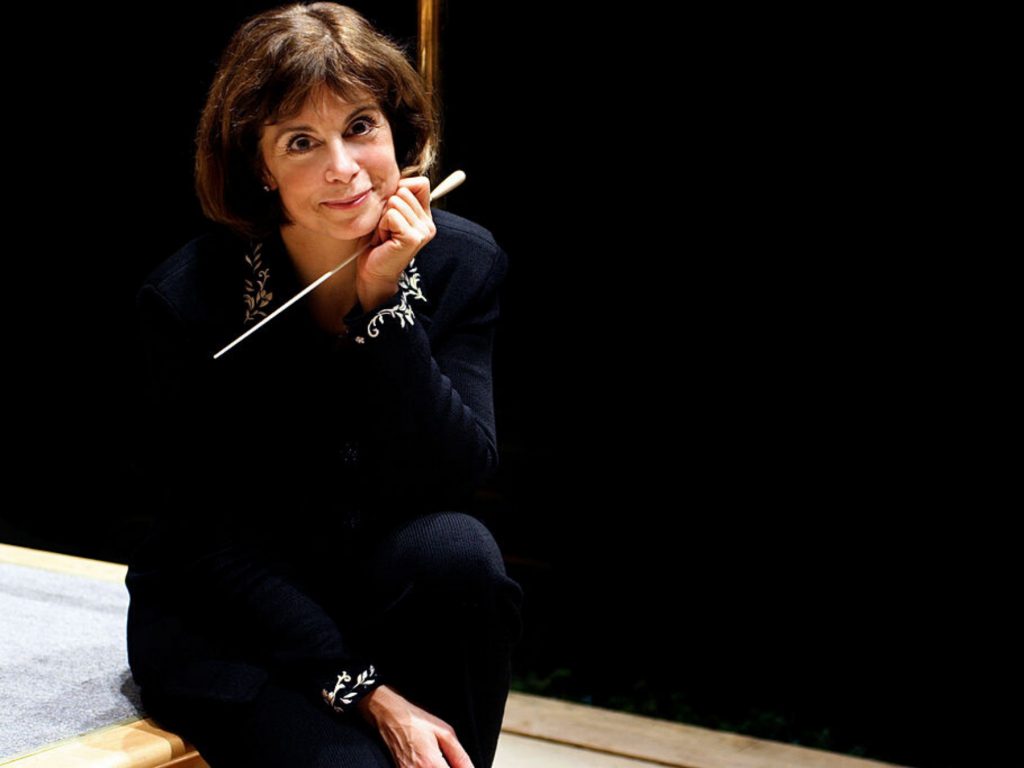
Grammy-winning conductor JoAnn Falletta serves as Music Director of the Buffalo Philharmonic Orchestra and the Virginia Symphony Orchestra, Principal Guest Conductor of the Brevard Music Center and Artistic Adviser of the Hawaii Symphony Orchestra. Hailed for having “Toscanini’s tight control over ensemble, Walter’s affectionate balancing of inner voices, Stokowski’s gutsy showmanship, and a controlled frenzy worthy of Bernstein”, she is a leading force for the music of our time.
Internationally celebrated as a vibrant ambassador for music and an inspiring artistic leader, Ms. Falletta is invited to guest conduct many of the world’s finest orchestras. She has guest conducted over a hundred orchestras in North America, and many of the most prominent orchestras in Europe, Asia, South America and Africa.
Biography source: http://www.joannfalletta.com/biography.html
Photo source: https://en.wikipedia.org/wiki/JoAnn_Falletta
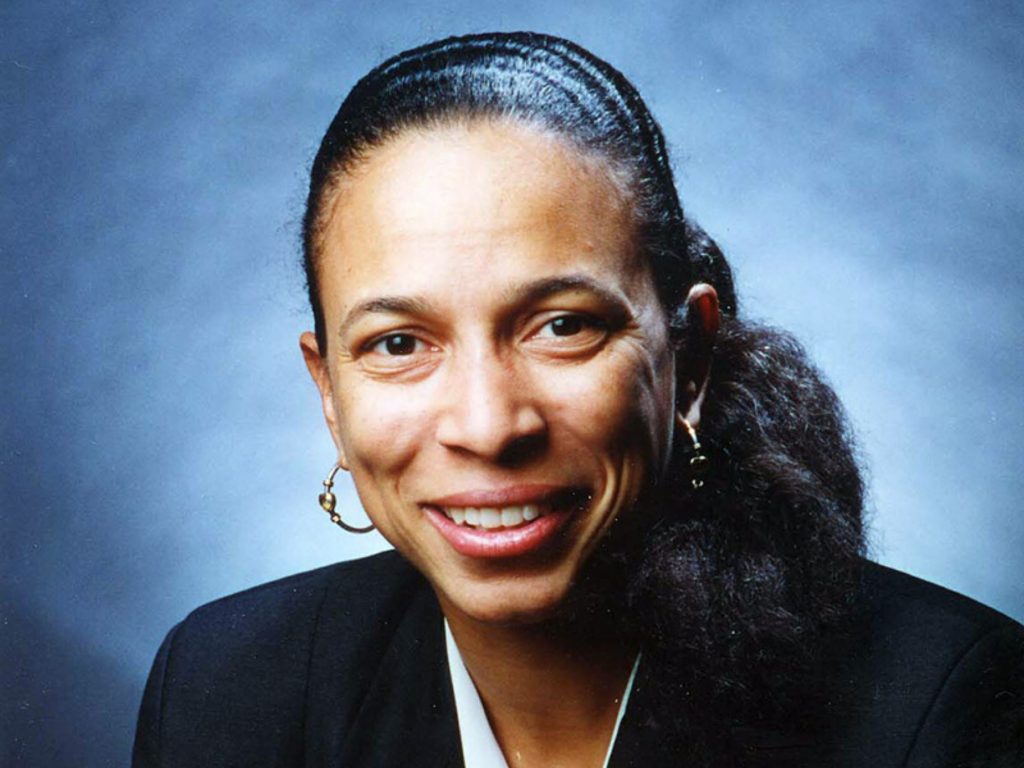
Kay George Roberts is the founder and music director of the New England Orchestra (NEO). Based in Lowell, Massachusetts, NEO is committed to building a vital artistic partnership with the community by linking cultures through music.
Guest conducting engagements have included the Cleveland Orchestra, the Chicago, Dallas, Detroit, Nashville and National Symphony orchestras as well as the Orchestra Svizzera Italiana, where she conducted Jazz greats Max Roach, Diane Reeves, and the New York Voices. Ms. Roberts has served as a cover conductor for the Boston Symphony Orchestra, the Cleveland Orchestra and Detroit Symphony Orchestra. In addition, she is the conductor for Philadelphia’s Opera North performances of Leslie Burrs’ award-winning opera, Vanqui. In 2006, The Washington Post praised her “intensely paced concert version of Vanqui, carefully balancing soloists, orchestra and chorus”.
An advocate for new and overlooked music, critics admire her “precision and passion” in leading audiences “to make new discoveries.” She premiered Jennifer Higdon’s Fanfare Ritmico at the Blossom Music Festival with the Cleveland Orchestra and was co-conductor for the highly acclaimed 2004 Sphinx Inaugural Gala Concert in Carnegie Hall. In 2007, she led the Sphinx Symphony in the world premiere of Michael Abels’ Delights and Dances in Detroit’s Orchestra Hall to celebrate the Sphinx Competition’s 10th anniversary.
A champion of music education, Ms. Roberts is a professor of music at the University of Massachusetts Lowell (UML) and director of the UML String Project, a community outreach program for public school students that fosters diversity in classical music. She is the first woman to earn the Doctor of Musical Arts degree in conducting from Yale University where she studied with Otto-Werner Mueller. Ms. Roberts also studied conducting at Tanglewood with Leonard Bernstein, Gustav Meier and Seiji Ozawa, and at the Bachakademie Stuttgart with Sir John Eliot Gardiner.
Photo source: https://www.uml.edu/fahss/music/faculty/roberts-kay.aspx
Biography source: http://www.operanorthinc.org/kay-george-roberts
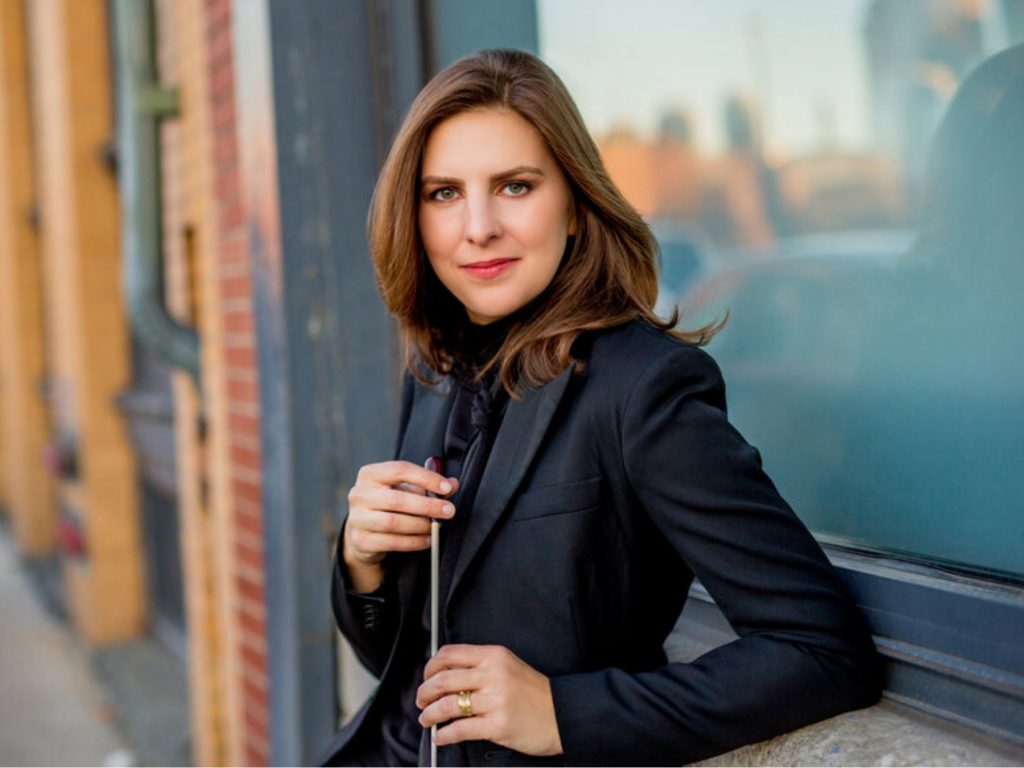
Russian-American conductor Lidiya Yankovskaya is a fiercely committed advocate for Russian masterpieces, operatic rarities, and contemporary works on the leading edge of classical music.
As Music Director of Chicago Opera Theater, this season Ms. Yankovskaya leads the world premiere of Dan Shore’s Freedom Ride and the Chicago premieres of Joby Talbot’s Everest, Rachmaninoff’s Aleko, and David T. Little’s Soldier Songs at Chicago Opera Theater. Elsewhere in the 19/20 season, she conducts Ricky Ian Gordon’s Ellen West at New York’s critically acclaimed Prototype Festival, and makes house debuts leading Daron Hagen’s Shining Brow at Arizona Opera and the world premiere of Paola Prestini’s Edward Tulane at Minnesota Opera. In standard repertoire, she leads performances of Stravinsky’s The Firebird at Illinois Philharmonic, Shostakovich’s Chamber Symphony in C minor at Chicago Philharmonic, and Mozart’s Don Giovanni in her Glimmerglass Festival debut.
Ms. Yankovskaya is Founder and Artistic Director of the Refugee Orchestra Project, which proclaims the cultural and societal relevance of refugees through music, and has brought that message to hundreds of thousands of listeners around the world. In addition to a National Sawdust residency in Brooklyn, ROP has performed in Boston, Washington, D.C., and the United Nations, and will make its UK debut in London in an upcoming season. She has also served as Artistic Director of the Boston New Music Festival and Juventas New Music Ensemble, where she led operatic experiments with puppetry, circus acts, and robotic instruments, as well as premieres by more than two dozen composers. Under her artistic leadership, Juventas was the recipient of multiple NEA grants and National Opera Association Awards.
Photo source: https://lidiyayankovskaya.com/
Biography source: https://lidiyayankovskaya.com/bio

There’s a rich assortment of music about springtime in the classical repertoire, ranging from Schumann’s Spring Symphony Op.38, to Beethoven’s “Spring” Violin Sonata Op.24 (not that Beethoven himself ever called it a “Spring” Sonata), to Vivaldi’s perennially popular (pun definitely intended) violin concerto, “Spring” from The Four Seasons. In fact, there’s so much classical music for this season, that for this list, we’ll narrow things down by featuring lovely but lesser-known pieces celebrating the return of spring.

Throughout Western music history, women have produced innovative, moving compositions, and the realm of early music is no exception. In this list, we’ll profile nine of the many pathfinding women who composed from the Middle Ages to the High Baroque.

If you’re familiar with the history of classical music, you may know that historically classical music hasn’t been the most welcoming field for women, and there is a long way to go before women classical composers of today are performed and recognized at the same level as their male peers. That said, here are some of our favorite contemporary women composers shaping the future of classical music, right now.
We hope you’ll give these compositions a listen, and fall in love with this music as we have. Want to share your thoughts? Get in touch via email: info@allclassical.org
Currently serving as Composer-in-Residence with the storied Philadelphia Orchestra and included in the Washington Post’s list of the 35 most significant women composers in history (August, 2017), identity has always been at the center of composer/pianist Gabriela Lena Frank’s music. Born in Berkeley, California (September, 1972), to a mother of mixed Peruvian/Chinese ancestry and a father of Lithuanian/Jewish descent, Gabriela explores her multicultural heritage most ardently through her compositions. Inspired by the works of Bela Bartók and Alberto Ginastera, Gabriela is something of a musical anthropologist. She has traveled extensively throughout South America and her pieces reflect and refract her studies of Latin American folklore, incorporating poetry, mythology, and native musical styles into a western classical framework that is uniquely her own.
Recommended Listening: Leyendas: An Andean Walkabout
A New York-based musician, vocalist, violinist, composer, and producer, who performs in solo and collaborative projects. She was the youngest recipient of the Pulitzer Prize for Music in 2013 for Partita for 8 Voices, written for the Grammy-winning Roomful of Teeth, of which she is a member. Recent commissions include new works for Renée Fleming with Inon Barnatan, Dawn Upshaw with Sō Percussion and Gil Kalish, the Orchestra of St. Luke’s with John Lithgow, the Dover Quartet and many more.
Recommended Listening: To the Hands: No. 6. I Will Hold You
Puerto Rican-born composer and multi-instrumentalist Angélica Negrón writes music for accordions, robotic instruments, toys and electronics as well as chamber ensembles and orchestras. Her music has been described as “wistfully idiosyncratic and contemplative” (WQXR) and “mesmerizing and affecting” (Feast of Music) while The New York Times noted her “capacity to surprise” and her “quirky approach to scoring”. Angélica is currently working on a lip sync opera titled Chimera for drag queen performers and chamber ensemble exploring the ideas of fantasy and illusion, as well as the intricacies and complexities of identity.
Recommended Listening: Sueño Recurrente


