Program Director John Pitman discusses the second release by the Calidore String Quartet, which contemplates the intersection of music and language. Violinist Estelle Choi, one of the four founding members of Calidore, shares how “the desire to explore the innate human drive for communication,” became the focus of their new recording. Choi describes the inspiration for Three Essays by Caroline Shaw, Robert Schumann’s String Quartet No. 3, and String Quartet No. 9 by Dmitri Shostakovich.
This playlist will take you on a whirlwind tour of chamber music by women, with appearances from a few of the brilliant composers who have contributed to the genre. We’ll start with some of the earliest chamber music by women, then travel toward the present day! Along the way, we’ll meet composers from many cultures and diverse heritages, hailing from Italy, Venezuela, France, China, Germany, England, and the United States.
Isabella Leonarda: Sonata duodecima for violin and continuo, Op. 16 no. 12
Composer Isabella Leonarda (1620-1704) was abbess from Novara, Italy, where she led her convent’s dynamic musical life. Leonarda composed and published many collections of harmonically adventurous and expressive sacred vocal music. She was such an influential figure in her city that a contemporary described her as “La musa novarese” (The Novarese Muse). Leonarda has the distinction of being the first woman to publish instrumental sonatas: her Op. 16 collection of twelve sonatas was published in Bologna in 1683. These sonatas exemplify the same lyrical melodic language and expressive chromaticism found in her sacred vocal works.
Élisabeth-Claude Jacquet de la Guerre: Trio Sonata in B-flat Major
Composer and harpsichordist Élisabeth-Claude Jacquet de la Guerre (1665-1729) spent her early years as a child prodigy in the court of Louis XIV. Subsequently, she established herself as one of the most important concert artists, composers, and teachers of music in late Baroque Paris. We have four trio sonatas by Jacquet de la Guerre. We don’t know exactly when she composed them, but we do know that Sébastian de Brossard copied them in 1695, perhaps for use in the music academy he directed in Strasburg.
Franziska Lebrun: Violin Sonata in B-flat Major for Violin and Piano, Op. 1 No. 1
Franziska Danzi Lebrun (1756-1791) was an operatic soprano from the talented Italian-German Danzi family: her brother was the cellist and composer Franz Danzi. Franziska Danzi launched her singing career in 1772, and soon joined the Mannheim Court Opera. In 1778, she married composer and Mannheim orchestra oboist Ludwig August Lebrun. The couple frequently appeared in concert together, performing arias for soprano with obbligato oboe. Both of their daughters would become professional musicians: Sophie Lebrun, a pianist, and Rosine Lebrun, an actress and singer. In 1779, the Lebruns traveled to London, where Franziska Lebrun sang at the King’s Theater, and where, in 1780, she composed and published two sets of violin sonatas.
Fanny Hensel: String Quartet in E-flat Major, Op. 277
This string quartet by Fanny Mendelssohn Hensel (1805-1847) is one of the first composed by a woman. She wrote the piece in 1834, and it received at least one performance in music salon Hensel hosted in her home. The work strays from strict classical forms and often leans more toward the improvisatory style of fantasia. Hensel’s brother, Felix Mendelssohn, criticized this tendency in the work, so different from his own preference for formal classicism. Discouraged by her brother’s reaction, Hensel never wrote another string quartet–but she also declined to change a note of the one she’d written.
Clara Schumann: Piano Trio in G minor, Op. 17
Clara Wieck Schumann (1819-1896) was an accomplished chamber musician–you can see an illustration of her collaborating with violinist Joseph Joachim at the top of this article. Clara Schumann composed her Piano Trio in 1846, a year of great stress for her. She and her family had recently relocated to Dresden, and her husband Robert became so ill that the burden of supporting him and their four children in an unfamiliar city fell mostly to Clara. She taught and concertized tirelessly, even performing a recital on July 27, a day after her diary hinted that she had suffered a miscarriage. The Trio’s sorrowful character may well reflect the challenges amid which it was written.
Teresa Carreño: String Quartet in B minor
Venezuelan pianist and composer Teresa Carreño (1853-1917) was one of the foremost touring virtuosos of her time. She began her career as a child prodigy (she played for Abraham Lincoln at the White House in 1863), and in addition to building an international career as a pianist, this versatile artist was also an opera singer and impresario. Many of her compositions were virtuoso vehicles for her piano appearances, but later in her career, she also composed works for strings, including a Serenade, and this string quartet in 1896.
Lili Boulanger: Nocturne for Violin and Piano (1911)
In 1909, Lili Boulanger (1893-1918) decided to compete as a composer for the Prix de Rome, France’s most prestigious arts prize. Due to her chronic ill health (which would lead to her death at the age of 24), she studied composition privately, and later part-time at the Paris Conservatory. In the midst of her work on a cantata to qualify for the prize, she took two days off in September of 1911 to compose this Nocturne. The next year, she became the first woman to win the Prix de Rome with her cantata Faust et Hélène.
Nadia Boulanger: Three Pieces for Cello and Piano (1914)
Nadia Boulanger (1887-1979) was devastated by the death of her beloved sister Lili in 1918. By the 1920s, she gave up composition altogether. Instead, she devoted her life to the promotion of Lili’s music, and became one of the twentieth century’s most influential teachers of composition. Nadia Boulanger was also a professional conductor and organist, and these Three Pieces originated as a set for organ. Boulanger arranged the set for cello and piano in 1914.
Rebecca Clarke: Morpheus (1918)
English violist and composer Rebecca Clarke (1886-1979) wrote Morpheus in 1917. At the time, she was touring America with her colleague, cellist May Mulke. Morpheus, a single-movement work for viola and piano, was one of several chamber pieces by Clarke in their tour repertoire. Morpheus premiered in a recital Clarke and Mulke presented in New York’s Aeolian Hall in February of 1918. The recital actually included two works by Clarke: one listed Clarke as composer, but Morpheus was programmed under a male pseudonym, “Anthony Trent.” Apparently Clarke used the pseudonymn for Morpheus because she felt self-conscious about her name appearing multiple times on one concert program. She explained, with poignant diffidence, “I thought how silly to have my name on the programme yet again.” Of the program’s two works by Clarke, critics paid much more attention to the one attributed to the supposedly male “Mr. Trent.”
Florence Price: “Calvary” from Five Folksongs (1951)
Florence Price (1887-1953) composed this, her third work for string quartet, in 1951. Like her G Major quartet (1929) and her A minor quartet (1935), this piece marries midcentury classical neo-romanticism with elements of modernism and influences from African-American musical traditions. In Five Folksongs, Price looks further back than the Classical-era string quartet for inspiration: she delves into neo-Baroque style, treating each of five African-American folk songs in polyphonic settings. The result is a compelling blend of folk music and academic music, old world and new.
Undine Smith Moore: Afro-American Suite (1969)
American composer Undine Smith Moore (1904-1989) studied at Fisk University, the Julliard School and Columbia University. She served on the music faculty of Virginia State University from 1927-1972, where her accomplishments included co-founding the Black Music Center, an organization for the study and promotion of music by Black artists. Moore was a dedicated choral composer who produced both original choral works, like her oratorio Scenes from the Life of a Martyr, as well as eloquent choral arrangements of spirituals. Moore’s Afro-American Suite (1969) translates her choral technique into the medium of chamber music. Each of its four movements is based on spirituals, lyrically adapted to the idioms of violin, flute and piano.
Liu Zhuang: Wind through Pines (1999)
Chinese-American composer Liu Zhuang (1932-2011) enjoyed a distinguished academic career, teaching at the Shanghai Conservatory, the Conservatory of Music in Beijing, and Syracuse University. She composed symphonic works, songs, and chamber music in a style that paired classical modernism with the melodic contours and harmonies of traditional Chinese music.
In her program note for her chamber work Wind through Pines, Zhuang said: “Wind Through Pines, describing the tranquility of a night in which the wind blows through a pine forest, explores tone colors of traditional Chinese instruments through modern instruments. The title refers to ancient poetic rhythms in terms of style and form – a sonic exploration of the poetry of music. The piano is prepared to sound like a Ching, a unique ancient plucked instrument. The flute represents the Xiao, a low-pitched Chinese wind instrument. Utilizing overtones and harmonies, the cello serves as unfixed tone, both dotted and solid touch. The piece is free-form, but not formless, like Chinese calligraphy, or when reading a poem with some words exaggerated.”
Gabriela Lena Frank: “Chasqui” from Leyendas: An Andean Walkabout
Composer and pianist Gabriela Lena Frank (b. 1972) is a Grammy-winner and the Composer-in-Residence for the Philadelphia Orchestra. She finds musical inspiration in her own Latinx heritage and her studies of Latin American history and culture, as displayed in works like Leyendas (Legends), An Andean Walkabout (2001).
In her programme note, Frank explains, “Leyendas: An Andean Walkabout for string quartet draws inspiration from the idea of mestizaje as envisioned by the Peruvian writer José María Arguedas, where cultures can coexist without the subjugation of one by the other. As such, this piece mixes elements from the western classical and Andean folk music traditions.”
Of the fourth movement, Frank says, “‘Chasqui’ depicts a legendary figure from the Inca period, the chasqui runner, who sprinted great distances to deliver messages between towns separated from one another by the Andean peaks. The chasqui needed to travel light. Hence, I take artistic license to imagine his choice of instruments to be the charango, a high-pitched cousin of the guitar, and the lightweight bamboo quena flute, both of which are featured in this movement.”
Curtis, Liane. “A Case of Identity: Rescuing Rebecca Clarke.” The Musical Times (May 1996). Made available through The Rebecca Clarkes Society, rebeccaclarke.org. Accessed March 4, 2021, rebeccaclarke.org/pdf/identity.pdf.
John interviews composer Osvaldo Golijov about the new album that features the Silkroad Ensemble. Falling Out of Time, which was written for the ensemble by longtime collaborator/composer Osvaldo Golijov, is an 80-minute tone poem based on David Grossman’s novel about parental grief and loss. In John’s interview with the composer, Mr. Golijov likened it to the dark, late works of Goya and Rembrandt. Falling Out of Time includes 13 tracks featuring 13 members of the Grammy Award-winning Silkroad Ensemble, and is a Silkroad Ensemble commissioned work.
What will classical music sound like for future audiences? We may not have the answers, but if these composers offer any indication, we are excited to see and hear where the future takes us.
SistaStrings
The sound of SistaStrings can’t be described in one word. Formed in 2014 after the sisters graduated from college, the Milwaukee-based duo combines their classical background with R&B with a touch of gospel influence that culminates in a vibey, lush sound. With thick string harmonies between violin and cello and soulful voices, SistaStrings takes you on a journey. The sisters not only write and arrange but find pleasure sitting in with musicians and exploring what sounds come from improvisation and spontaneity. SistaStrings has performed with Malik Yusef, opened for Black Violin, Bone Thugs ‘N Harmony, Lupe Fiasco, BJ The Chicago Kid, and The Roots. Outside of playing music venues, SistaStrings goes into schools and conducts assemblies, encouraging young people to pursue the arts and to not be afraid of hard work. The ladies are advocates for diversity in the arts and promote social justice in all that they do musically. Biography and photo courtesy of SistaStrings.com
Kevin Day
Kevin Day, an American composer whose music has been “characterized by propulsive, syncopated rhythms, colorful orchestration, and instrumental virtuosity,” (Robert Kirzinger, Boston Symphony Orchestra) Kevin Day (b. 1996) has quickly emerged as one of the leading young voices in the world of music composition today. Day was born in Charleston, West Virginia and is a native of Arlington, Texas. His father was a prominent hip-hop producer in the late-1980s, and his mother was a sought-after gospel singer, singing alongside the likes of Mel Torme and Kirk Franklin. Kevin Day is a composer, conductor, producer, and multi-instrumentalist on tuba, euphonium, jazz piano and more, whose music often intersects between the worlds of jazz, minimalism, Latin music, fusion, and contemporary classical idioms. Day currently serves as the Composer-In-Residence of the Mesquite Symphony Orchestra. Biography and photo courtesy of kevindaymusic.com
Ayanna Witter-Johnson
Singer, songwriter, cellist Ayanna Witter-Johnson is a rare exception to the rule that classical and alternative r&b music cannot successfully coexist. Graduating with a first from both Trinity Laban Conservatoire of Music and Dance and the Manhattan School of Music, Ayanna was a participant in the London Symphony Orchestra’s Panufnik Young Composers Scheme and became an Emerging Artist in Residence at London’s Southbank Centre. She was a featured artist with Courtney Pine’s Afropeans: Jazz Warriors and became the only non-American to win Amateur Night Live at the legendary Apollo Theatre in Harlem, NYC. A performer of extraordinary versatility her live shows are intimate journeys that chronicle her experience as a female artist in the 21st century. Because of her musical prowess, mesmerising vocals, non-compromising lyrics and ability to deftly reinterpret songs on the cello, Ayanna is able to straddle both the classical and urban worlds effortlessly. Biography and photo courtesy of ayannamusic.com
Philip Herbert
From an early age Philip Herbert’s talent for music was nurtured by his parents, and later at the Yorkshire College of Music, where he was awarded a scholarship to further develop his musical studies at the piano, with the late Dr. John Foster, and Irene Ingram. He later went on to complete a Bachelor’s degree in Music Education at King Alfred’s College, Winchester, and later to read music at postgraduate level at Andrews University, Michigan USA. He also gained piano teaching and piano performing diplomas from the Royal Academy and Royal College of Music respectively. Philip has taught music at all educational levels, as well as making music through composing, performing as a pianist and conducting. He has coordinated master classes, workshops and concert series; as well as devised courses and community projects for young people and adults, with creative and interactive contributions from some of Britain’s finest musicians, across an eclectic range of musical genres. He has also been involved in projects that have been broadcast on BBC Radio 2, 3 and 4 as well as BBC TV. Biography and photo courtesy of philipherbert.org.
All Classical Portland celebrates the music of Black composers and artists year-round, and this month, we invite you to join us as we take a closer look at the contributions that Black composers and musicians have made to classical music. Let’s meet a few of the artists whose music you’ll hear on the air this month, and year round on All Classical Portland.
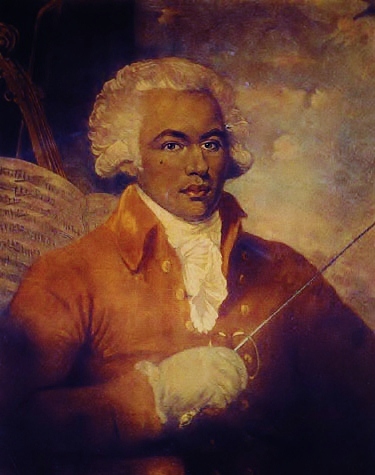
Joseph Bologne, Chevalier de Saint-Georges, French Composer
Composer and violinist Joseph Bologne (1745-1799) lived one of the most adventurous lives in the history of classical music. His father was a white French planter in Guadaloupe, and his mother was an enslaved woman of African descent. Unlike many biracial children in his position, Bologne’s father acknowledged his son and provided him with an education and the family title of “Saint-Georges” upon the family’s ennoblement in 1757.
Bologne studied in France with a renowned fencing master and became a Chevalier (knight) and a Gendarme de la Garde du Roi–a member of the royal police guard. He quickly earned a reputation as one of the finest swordsmen and boxers in Europe. Bologne was appointed the colonel of a French regiment of “citizens of color” in 1792. One person who served under Bologne was Thomas-Alexandre Dumas, whose military service inspired his son Alexandre Dumas to write swashbuckling novels like The Count of Monte Cristo and The Three Musketeers.
Concurrently with his career as a swordsman, Bologne became known as one of Europe’s finest conductors and violinists. He directed several orchestras throughout his career, including one which he founded, the Concert de la Loge Olympique. It was as director of this ensemble that Bologne commissioned Haydn’s Paris Symphonies. Bologne was also considered as a potential director for the Paris Opéra, but was blocked from the appointment when four of the company’s prima donnas objected to taking direction from a biracial person. Instead, he achieved success as a composer of opera for the musical establishments of aristocratic clients. He also composed extensively for orchestra and for his own instrument, the violin.
Our celebration on February 1 will include a couple works by the Chevalier de Saint-Georges, including his Symphony in G Major, Op. 11 No. 1.
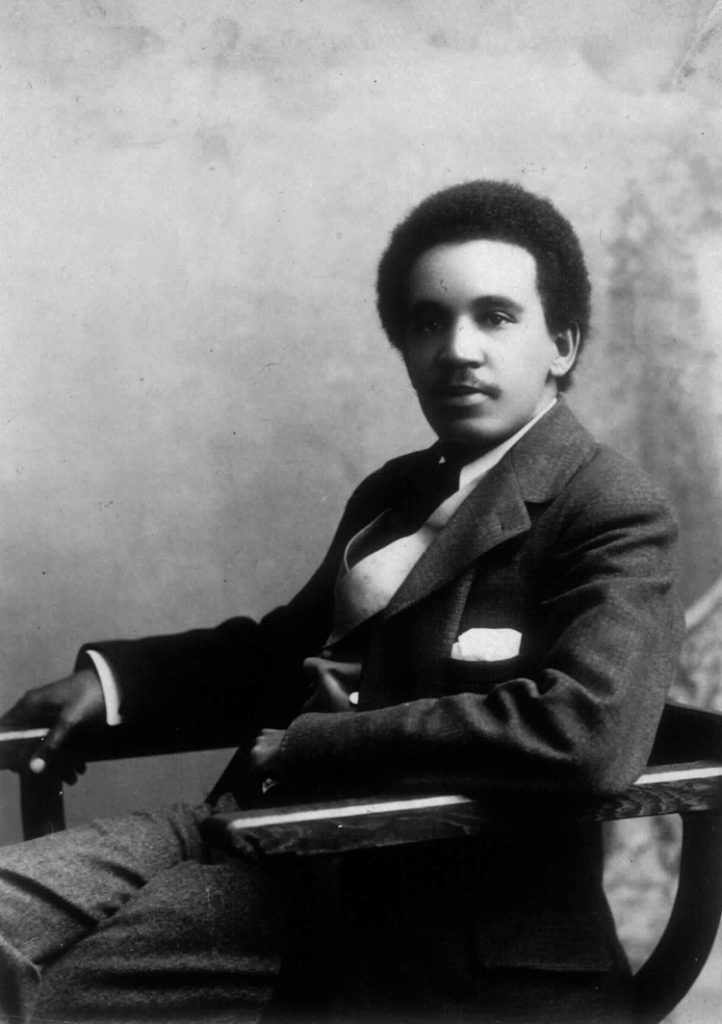
Samuel Coleridge-Taylor (1875-1912) was a prominent voice in English music’s late Romantic era. Born in London, Coleridge-Taylor was raised by his mother, a single parent. His father had been unable to establish a career as a Black physician in England, so he returned to his native Sierra Leone when Samuel was a child.
A violinist and composer, Samuel Coleridge-Taylor studied under Charles Villiers Stanford at the Royal College of Music, and he received one of his first composition commissions at the suggestion of Edward Elgar. Coleridge-Taylor established a career in England as a professor at the Trinity College of Music and as a choral conductor, including a long tenure as director of the Handel Society of London.
Coleridge-Taylor was deeply interested in the music and society of African Americans, particularly after hearing a touring performance by the Fisk Jubilee Singers. He made three professional visits to the United States, during which he met President Teddy Roosevelt, collaborated with Black composer and baritone Harry Thacker Burleigh, conducted the Marine Band, and toured with the Coleridge-Taylor Choral Society, a Washington, D.C. ensemble of Black musicians that had been formed in his honor. Coleridge-Taylor became an inspirational figure to African American composers, including William Grant Still, and in turn, African American music became a strong influence in Coleridge-Taylor’s compositional style.
Coleridge-Taylor’s career was cut short by his early death in 1912, but his legacy continued in the work of his daughter and biographer, the composer Avril Coleridge-Taylor.
Our celebration on February 1 will include a performance of Samuel Coleridge-Taylor’s Violin Concerto in G minor, Op. 80 (1911).
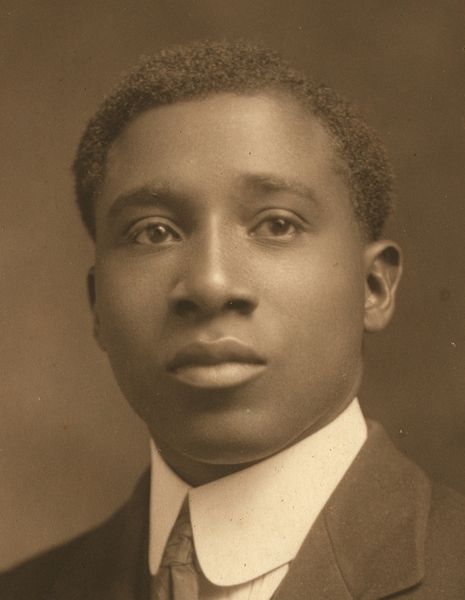
Photograph of Nathaniel Dett courtesy of Wikimedia Commons.
Robert Nathaniel Dett (1882-1943) was born in Drummondville, Ontario, Canada (now part of Niagara Falls, Ontario). His ancestors and were among the freedom-seekers who had escaped to Canada via the Underground Railroad. In fact, Drummondville was a community founded by freedom-seekers.
Dett distinguished himself at Oberlin Conservatory and the Eastman School of Music, as well as studying with composers Arthur Foote and Nadia Boulanger. Dett was a dedicated choral conductor who taught for almost two decades at the Hampton Institute, now Hampton University, a historically Black university. Under his leadersip, the Hampton Singers rose to artistic prominence, touring internationally and singing for President Herbert Hoover. Among the many students whose musicianship he encouraged was Dorothy Maynor, who would go own to record Aida under Toscanini, and to found the Harlem School of the Arts. You can read more about Maynor in another of our blog posts: Nine Black Women Who Changed Opera Forever.
Dett’s music exhibits a warm, Romantic musical language. Many of his compositions reflect his love of sacred choral music, including spiritual arrangements as well as original vocal compositions. Dett also composed extensively for his primary solo instrument, the piano, especially suites of programmatic pieces.
On February 1, you will hear Dett’s lyrical 1922 suite of character pieces for piano, Cinnamon Grove.
The music of Florence Price (1887-1953) has been enjoying a renaissance since 2009, when a cache of her scores was rediscovered in her former summer home in Chicago. Price achieved many firsts during her career as a composer and educator, which more than merit a reacquaintance with her body of work.
Price was born in Little Rock, Arkansas, and was an intellectual prodigy–she graduated high school, as valedictorian, at the age of fourteen. Price studied at the prestigious New England Conservatory of Music, one of the few conservatories that accepted students of color at the turn of the twentieth century. She pursued an academic career in the South, becoming head of the music department at Clark College in Atlanta, but racial violence and professional discrimination led her to move with her family to Chicago in 1927.
In Chicago, Price gained recognition as a composer. In 1932, her Symphony in E minor won the Wanamaker Competition, which led to its 1933 premiere with the Chicago Symphony Orchestra under Frederick Stock. This made Price the first Black woman to have a symphony performed with a major American orchestra. Particularly gifted as a vocal composer, Price’s art songs were taken up by singers like Marian Anderson and Leontyne Price. Her Songs to the Dark Virgin, a setting of Langston Hughes, is a particularly fine example of her musicianship.
We’ll hear several works by Florence Price during our celebration, including her Concerto in One Movement for Piano, performed by pianist and Price scholar Dr. Karen Walwyn.
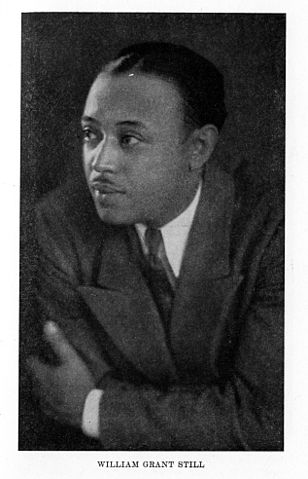
The wide-ranging, trailblazing career of William Grant Still (1895-1978) has earned him the title “Dean of African-American Composers.” He accomplished a significant number musical firsts. In 1930, his Symphony No. 1, “Afro-American,” was the first symphony by a Black composer performed by a major orchestra: it premiered under Howard Hanson in a performance by the Rochester Philharmonic Orchestra. Still was also the first African-American to conduct a major American symphony orchestra, directing the Los Angeles Philharmonic in 1936. And in 1949, New York City Opera’s production of his Troubled Island, with a libretto by Langston Hughes and Verna Arvey, made Still the first African-American to have an opera performed by a major American opera company.
Still was born in Mississippi and educated at Wilberforce University and Oberlin College. He studied with George Whitefield Chadwick and Edgard Varèse, and built a career in Los Angeles arranging music for television and film. His prolific concert music output includes eight operas, five symphonies, and choral works including the stark work of protest, And They Lynched Him on a Tree (1940).
Our celebration on February 1 will include a broadcast of Still’s historic, blues-inflected “Afro-American” Symphony.
James DePreist (1936-2013) was the beloved long-time conductor of the Oregon Symphony. Born in Philadelphia, DePriest grew up surrounded by music, thanks in great part to the encouragement of his aunt, contralto Marian Anderson (1897-1993). DePreist credited Anderson with nurturing his love of music by sharing classical recordings with him when he was a child. Their tie remained strong for a lifetime: Marian Anderson spent her last days with her nephew in Portland.
Our celebration will include a vintage recording of Marian Anderson singing the spiritual “Heaven, Heaven.” Read more about Marian Anderson.
Portrait of James DePreist from Africlassical.com
James DePreist studied at the Philadelphia Conservatory, originally specializing in composition and jazz. In 1962, he traveled to Bangkok as a jazz specialist under the auspices of the State Department. During this visit, DePreist discovered his love of orchestral conducting, but he also contracted polio, which would lead to a permanent disability. Despite this setback, DePreist won the coveted position of Assistant Conductor of the New York Philharmonic under Leonard Bernstein in 1965.
In 1980, DePreist became Music Director of the Oregon Symphony, where he served until 2003. During Maestro DePreist’s tenure, the Oregon Symphony grew from a respectable regional orchestra to the ensemble of national standing we enjoy today. In addition to his career as a conductor, DePreist was also a poet, whose works include the collections This Precipice Garden (1986) and The Distant Siren (1989).
You’ll hear several recordings by James DePreist in our February 1 celebration, including a performance of Rachmaninov’s Symphony No. 2 in E minor, Op. 27, with the Oregon Symphony.
Portrait of Adolphus Hailstork from Theodore Presser
Adolphus Hailstork (b. 1941) is among the most distinguished composers working in America today. A student of David Diamond and Nadia Boulanger, Hailstork’s works have been conducted by Kurt Masur, Daniel Barenboim, James DePreist, JoAnn Falletta, and many other leading international conductors. He has received commissions from arts organizations including the Detroit Symphony, the Opera Theatre of St. Louis and the Los Angeles Philharmonic. Hailstork also serves as Professor of Music and Eminent Scholar at Old Dominion University.
In interviews, Hailstork has explained that he is a musical eclectic. He finds inspiration in the liturgical music of the Episcopal Church, where he received his first musical training as a child; in the music of Samuel Barber and other American neo-Romantics in the European classical tradition; and in musical traditions that are distinctly African-American. In a a June 2020 interview with San Francisco Classical Voice, Hailstork explained,
“I like to tell people that I’m a cultural hybrid and sometimes it’s agonizing. Sometimes I feel like I was hanging by my thumbs between two cultures. And then I just said to myself — after years of this, I said, “Look, I accept myself as a cultural hybrid, and I know I have trained in Euro-classical skills and I also am very interested — and since I went to school in an African American college — I am aware of that culture too. And I use them both.”
Hailstork’s music is often highly topical. In 2008, he completed Set Me On a Rock, a commission for the Houston Choral Society exploring the disaster of Hurricane Katrina. As of this year, one of his current projects is a work for choir and orchestra with text by Dr. Herbert Martin, entitled A Knee on a Neck–a tribute to George Floyd.
We’ll hear several works by Adolphus Hailstork throughout the day on February 1, including a performance of his Adagio for Strings by the Ambrosia Quartet.
Portrait of Valerie Coleman from vcolemanmusic.com
Flutist and composer Valerie Coleman (b. 1970) is one of the many exciting Black women working in contemporary classical music. She is the recipient of multiple accolades: in 2020 she was named Performance Today’s “Classical Woman of the Year,” and the Washington Post recently named her one of the “Top 35 Women in Classical Music.”
Coleman hails from Kentucky, and she achieved distinction in music from an early age: her artist biography recalls that she “began her music studies at the age of eleven and by the age of fourteen, had written three symphonies and won several local and state performance competitions.”
Coleman enjoys a busy schedule of composition commissions and solo flute appearances. She serves on the music faculty of the University of Miami, and is the founder and first director of the internationally-acclaimed, Grammy-nominated chamber ensemble, Imani Winds.
You’ll hear Imani Winds performing Coleman’s music in our Feburary 1 celebration. Our programming includes selections from her 2007 work for wind quintet, Portraits of Josephine. This suite explored the life of another remarkable Black woman, the singer, performer, and activist Josephine Baker.
The Piano Magazine has said that Lara Downes (b. 1973) is “A trailblazing pianist who combines exquisite musicality with an acute awareness of how an artist can make a positive and lasting social impact.”
Downes is a concert pianist whose artistic education included studies at European centers like the Hochschüle für Musik in Vienna, the Mozarteum in Salzburg, and the Paris Conservatory. She has cultivated an artistic perspective seamlessly integrating classical and vernacular traditions.
Downes’s performances focus particularly on underrepresented composers. She has recorded works by Clara Schumann and Margaret Bonds, and Florence Price’s Piano Concerto in D minor is a central part of her concert repertoire. In addition to her concert and recording work, Downes is the host of NPR’s Amplify with Lara Downes, in which she interviews Black musicians from across genres.
Our celebration on February 1 will feature several recordings by Lara Downes, including her interpretation of Billie Holiday’s Don’t Explain with cellist and vocalist Leyla McCalla.
As we look forward to this year’s Festival of Carols on All Classical Portland, it’s time to again share the stories of twelve famous carols! Our Program Director, John Pitman, has chosen a lovely selection of twelve carols for us to explore this year, and as All Classical’s Music Researcher, it’s been my mission to track down their origins, following the trails of Renaissance dance tunes, Valencian shepherds, plays by Molière, and sixteenth-century English tailors. Enjoy the journey!
This villancico, or Spanish carol, comes to us from the Aragonese royal court in Valencia in the early sixteenth century. The carol appeared in Villancicos de diversos autores, a 1556 collection of Valencian villancicos published in Venice. Riu, riu, chiu has been attributed to Catalan composer Mateo Flecha the Elder (1481-1553), who worked in Valencia as director of the chapel choir of the Duke of Calabria. The carol’s text, which is possibly by Juan del Encina (1468-1529/30), uses a real Spanish shepherds’ call, “Riu, riu, chiu.” It tells of God, portrayed as a shepherd, protecting the Virgin Mary from Satan, portrayed as a wolf.
Partamos a Belén
In Venezuela, Puerto Rico, and many other parts of Latin America, groups of carolers, or parranderos, travel from house to house to sing songs of Christmas called aguinaldos. The word aguinaldocan also refer to a Christmas gift: a musical aguinaldois really a gift of music. Sometimes these seasonal greetings are sung unaccompanied, but often instruments are involved, especially the cuatro, a four-stringed Latin American guitar. Partamos a Belén(Let Us Go to Bethlehem) is an aguinaldoby Venezuelan composer César Alejandro Carrillo (b. 1957). Carrillo is a choral conductor and composer who is particularly interested in preserving Venezuelan folk music traditions like the aguinaldo. In his preface to his score, Carrillo explains that his composition teacher “always instilled in us the cultivation of this genre in the repertoire of our choirs and as creative work, in order to preserve it from disappearance before the overwhelming invasion of other musical genres strange to our traditional Christmas holidays.” (Carrillo, Dos alguinaldos venezolanos, Musicarrillo Ediciones, 2018)
The Huron Carol, or Jesous Ahathonhia, is Canada’s oldest Christmas carol. Its tune is even older than its text: the music first appeared in Italy in the 16th century as a song to a dance rhythm, called La monica. The tune became popular throughout Europe, eventually making it to France as a song called Une jeune fillette, which was transformed into a noël, or French carol, around 1557, with the text Une jeune pucelle.
The text of The Huron Carol is by St. Jean de Brébeuf (1593-1649), a Jesuit missionary to the Huron-Wendat Native peoples in what is now the province of Ontario. Using the tune of Une jeune pucelle, Brébeuf wrote Jesous Ahathonhia, a new hymn in the Wendat language. Brébeuf’s hymn places the Christmas story into the context of Huron-Wendat religious concepts. The 1927 English version by Jesse Edgar Middleton, ’Twas in the Moon of Wintertime, is not a translation of Brebeuf’s text, though it does honor the spirit of the original by using indigenous imagery.
Go, Tell It on the Mountain
This Christmas spiritual was first cataloged in 1907 by John Wesley Work II (1873-1925). A professor of history at Fisk University, and director of the Fisk Jubilee Singers, Work was one of the first musicologists to make a scholarly study of African-American spirituals. His book Folk Song of the American Negro, co-written with his brother, composer Frederick J. Work, was one of the first authoritative volumes on spirituals. The Fisk Jubilee Singers had included arrangements of Go Tell It on the Mountain in their repertoire for years before the spiritual was first published in a 1909 anthology. The Work family musical dynasty continued with scholar and composer John Wesley Work III, who wrote a new anthem arrangement of Go, Tell It on the Mountain in 1940. The tradition of anthem arrangements continued with settings by composers like R. Nathaniel Dett and Moses Hogan.
Mary Had a Baby
This haunting carol was first published in N.G.J. Ballanta-Taylor’s 1925 collection, Negro Spirituals of Saint Helena’s Island. Ballanta-Taylor (1893-1961) was a Sierra-Leonean composer and ethnomusicologist, and one of the first scholars to study spirituals in the context of African musical traditions. The Penn Normal Industrial School of St. Helena, South Carolina, enlisted Ballanta-Taylor in the 1920s to make a special study of African-American spirituals, especially in the Sea Islands. These isolated islands had historically been a center of the Gullah, a community of African-Americans who created a unique culture blending Native American, European, and African languages and traditions. Ballanta-Taylor likely collected this spiritual from Saint Helena Island, off the coast of South Carolina.
The Sussex Carol
We can thank Ralph Vaughan Williams (1872-1958) for the popularity of this English folk carol. The text had been known since 1684, when it was published by Luke Wadding, a Franciscan bishop from Ireland. Many tunes subsequently became attached to Wadding’s text, but the one heard most today comes from the early 20th-century efforts of British composers to collect and transcribe authentic folk music. Vaughan Williams collected the tune known now as The Sussex Carol from the singing of Harriet Verrall, a resident of the village of Monk’s Gate, near Horsham, in Sussex. Vaughan Williams published his arrangement of the tune in his Eight Traditional Carols (1919), and soon it became a classic of the English carol repertory.
Es ist ein Ros’ entsprungen
This lovely carol is sung in English as “Lo, How a Rose E’er-Blooming.” It is thought to come from the diocese of Trier in the fifteenth or sixteenth century. This ancient city is located on the western border of modern Germany, near Luxembourg. Both text and tune probably developed gradually as a regional folk carol. It draws on a passage from the biblical book of Isaiah which tells of a “branch coming from the stem of Jesse,” traditionally interpreted as prophecy of the birth of Christ. Since the Middle Ages, the “stem” had frequently been depicted in art as a rose. (You may have heard similar iconography in medieval English carols, like There Is No Rose of Such Virtue.) Es ist ein Ros’ is most frequently sung to a 1609 arrangement for four voices by German composer Michael Praetorius (1571-1621).
The Coventry Carol
Mystery plays, which tell biblical stories through drama and song, originated in the Middle Ages as church-sponsored religious education. By the time The Coventry Carol made its appearance as part of the Coventry Mystery Plays in the 16th century, the tradition had wandered out of the church and become more entertainment than edification. The Coventry plays were presented during Midsummer festivals, performed not by clergy, but by the guilds of the Shearmen and Tailors. The Coventry Carol comes from a mystery play depicting the birth of Christ, where it is sung by the mothers of Bethlehem on the occasion of the Massacre of the Innocents: a story from the gospel of Matthew in which King Herod tries to kill the Christ Child by destroying all the infants in Bethlehem.
In 1940, The Coventry Carol took on an added poignancy. After the city of Coventry was bombed by Axis forces on November 14, the provost of Coventry Cathedral broadcast a Christmas Day radio message of forgiveness, and then the cathedral choir sang the Coventry Carol from within the cathedral’s ruins.
The Holly and the Ivy
Evergreen plants like holly have been a fixture of British solstice celebrations since the time of the Druids–in fact, the plant’s name derives from an Old English word for “holy or “sacred.” When Christianity came to the Europe, the church borrowed several pagan traditions for the midwinter Christmas festival: holly, with its blood-red berries and thorny leaves, was used to represent Christ, and evergreen ivy became a symbol of the Virgin Mary. The Holly and the Ivy is a traditional English carol on this topic: its text has appeared in English broadsides since at least 1710, though the carol may be older than that. In the early 20th century, English folk-song scholar Cecil Sharp (1859-1924) collected the carol’s music and text as sung by Mary Clayton of Gloustershire. Published in 1911, this became our standard version of the carol.
Noël nouvelet
This traditional carol is at least as old as the fifteenth century, when its text was preserved in a French manuscript. The original French poem tells the charming story of a dream which begins with a garden and a rosebud and goes on to reveal the story of the Christ Child. The carol’s final stanza explains that the poem is structured to tell its story in twelve verses, one verse for each of the twelve days of Christmas. The lovely minor-mode tune of Noël nouvelet may be as old as its text. In English-speaking countries, the carol is sometimes sung to the text “Sing We Now of Christmas,” which is such a loose translation of the French that is can be considered a new carol altogether.
Bring a Torch, Jeannette, Isabella
This is a traditional carol from Provençe: its original title in Provençal is Vénès leou vieira la Pieoucelle. French poet Émile Blémont (1839-1927) adapted a French version of this carol in 1901, as Un flambeau, Jeannette, Isabelle! The best-known English versions are based on Blémont’s translation. The text is inspired by traditional Provençal Christmas celebrations, including processions with torches, and the building of cribs (small Nativity scenes) placed inside model villages with tiny figurines called santons (which means “little saints”). The santons generally included the Virgin Mary, St. Joseph, the Christ Child, and other members of the nativity story, as well as visiting Provençal villagers (presumably, in this carol’s crib, two of the visitors were named Jeannette and Isabelle).
The tune of Bring a Torch, Jeannette, Isabella, comes from an air à boire (drinking-song) which the French composer Marc-Antoine Charpentier (1643-1704) composed for a production of Molière’s farcical play Le Médecin malgré lui (The Doctor in Spite of Himself) in 1666. Charpentier also composed a delightful Messe de minuit pour Noël (Christmas Midnight Mass), which he built from the melodies of old French carols, including our old friend “Une jeune pucelle” from the Huron Carol. Charpentier might be amused to learn that one of his own secular compositions eventually transformed in the other direction, and turned into a carol.
Ding Dong Merrily on High
If this carol tends to get your toes tapping, there’s good reason for that: the tune is actually a raucous Renaissance couples’ dance entitled “Branle de l’official.” The dance first appeared in Orchésographie (1588), a book on social dance by French cleric Jehan Tabourot (1520-1595). (He published the book under the anagrammatical nom de plume Thoinot Arbeau, perhaps because dance treatises were not the typical publications of priests.) Another ordained gentleman, the Rev. George Ratcliffe Woodward (1848-1934), wrote the carol text we now associate with Arbeau’s branle. Woodward was a scholar of Anglican church music who published several collections of carols, including the Cambridge Carol Book (1924), in which “Ding Dong Merrily on High” first appeared with a harmonization by Irish composer Charles Wood (1866-1926). As you may have guessed, the Rev. Woodward was also a devotee of bell-ringing.
Jones, Dorothy E., and William E. Studwell. “George Ratcliffe Woodward, Editor of The Cowley Carol Books.” Music Reference Services Quarterly, 6:4 (1998), 73-75. https://doi.org/10.1300/J116v06n04_16.
Keyte, Hugh, and Andrew Parrott. The New Oxford Book of Carols. New York: Oxford University Press, 1998.
Lamport, Mark A., Benjamin K. Forrest and Vernon M. Whaley. Hymns and Hymnody: Historical and Theological Introductions, Volume 2: From Catholic Europe to Protestant Europe. Eugene, Oregon: Cascade Books, 2019.
The clarinet is one of the most ubiquitous and versatile instruments, has a wide range of natural habitats, from singing out through the symphony to famous jazz tunes. Our modern family of clarinets can be traced as far back as 1690 to a man named Johann Christoph Denner. At that time, there was another instrument already in existence called the chalumeau, which produced a lovely sound in lower registers, but could not match the rich sound of the clarinet in the wide range of sound it produces. In this article we focus on Black clarinetists without whom our musical world would not be the same.
Portland Music Therapy is a branch of The Sage Center, a Holistic Health community of Alternative Health Specialists, that focuses on using Neurologic Music Therapy techniques to achieve non-musical goals like improved socialization and communication skills. They incorporate evidence-based research and individualized, quantifiable goals and objectives. They specialize in working with individuals on the autism spectrum, individuals with dementia and Alzheimer’s disease, and individuals with intellectual and developmental disabilities.
Portland Music Therapy utilizes music to enable those without language to communicate and express themselves non-verbally. For dementia patients, they use music to help increase memory recall which then contributes to reminiscence and satisfaction with life. They also use music as a way to increase social interaction with caregivers and families, as well as a platform for non-verbal expression.
Portland Music Therapy offers individual sessions that result in constantly evolving measurable goals and objectives catered to the specific strengths and opportunities for the client. They also offer music lessons on piano, guitar, voice, as well as music theory lessons. Portland Music Therapy takes pride in being able to help every client on their musical journey regardless of age, cognitive level, disability, or experience. In addition to individual lessons, Portland Music Therapy also offers group sessions when its clear that two or more clients are mutually beneficial to each other’s growth. The musical activities within these sessions are introduced within individual sessions so that everyone is confident and excited about their role in the group setting. Family-Centered In-Home sessions are another opportunity that Portland Music Therapy offers during which they work with clients in their familiar settings, using music to address some of the challenges to daily routines.
For more information, reach out to Kate Harris, MT-BC, at (662) 202 – 2777 or kate@portlandmusictherapy.com
Since the early days of opera, women composers have given us works with fascinating characters and unique perspectives. From Francesca Caccini’s 1625 opera, La liberazione di Ruggiero, to the latest installments of Shirley J. Thompson’sHeroines of Opera series, this list will explore just a few operas by women from throughout history. In these works, you’ll meet powerful sorceresses, conflicted goddesses, patient sisters, passionate mothers, and freedom fighters. You’ll also meet composers who are just as memorable as any character onstage. I hope these samples will encourage you to explore the vast world of operas by women.
National Radio Day crackles to life on August 20th every year in the United States for us to celebrate the miracle of sound waves travelling to our ears from far and wide. The history of National Radio Day is about as fuzzy as an untuned radio though, with rumors of its beginnings lying somewhere in the early 1990s. The purported seed of this holiday is the WWJ radio station in Detroit, Michigan, who began its daily broadcasts as the “Detroit News Radiophone” on August 20, 1920, as one of the first pioneers of commercial radio (via Wikipedia).
In honor of National Radio Day, All Classical Portland Intern Kelly Lantz interviewed our Chief Engineer Mike Alston on what it’s like to run the technical magic behind the music. Mike has a vast wealth of knowledge and experience in this field and is an excellent storyteller, so if you’re curious about how you’re able to hear the dulcet tones of All Classical Portland on your own radio, read on!